
Check the payment flow before transferring funds
PayID directs bank transfers using an identifier, but the payment rail does not establish whether a casino is lawful or trustworthy.
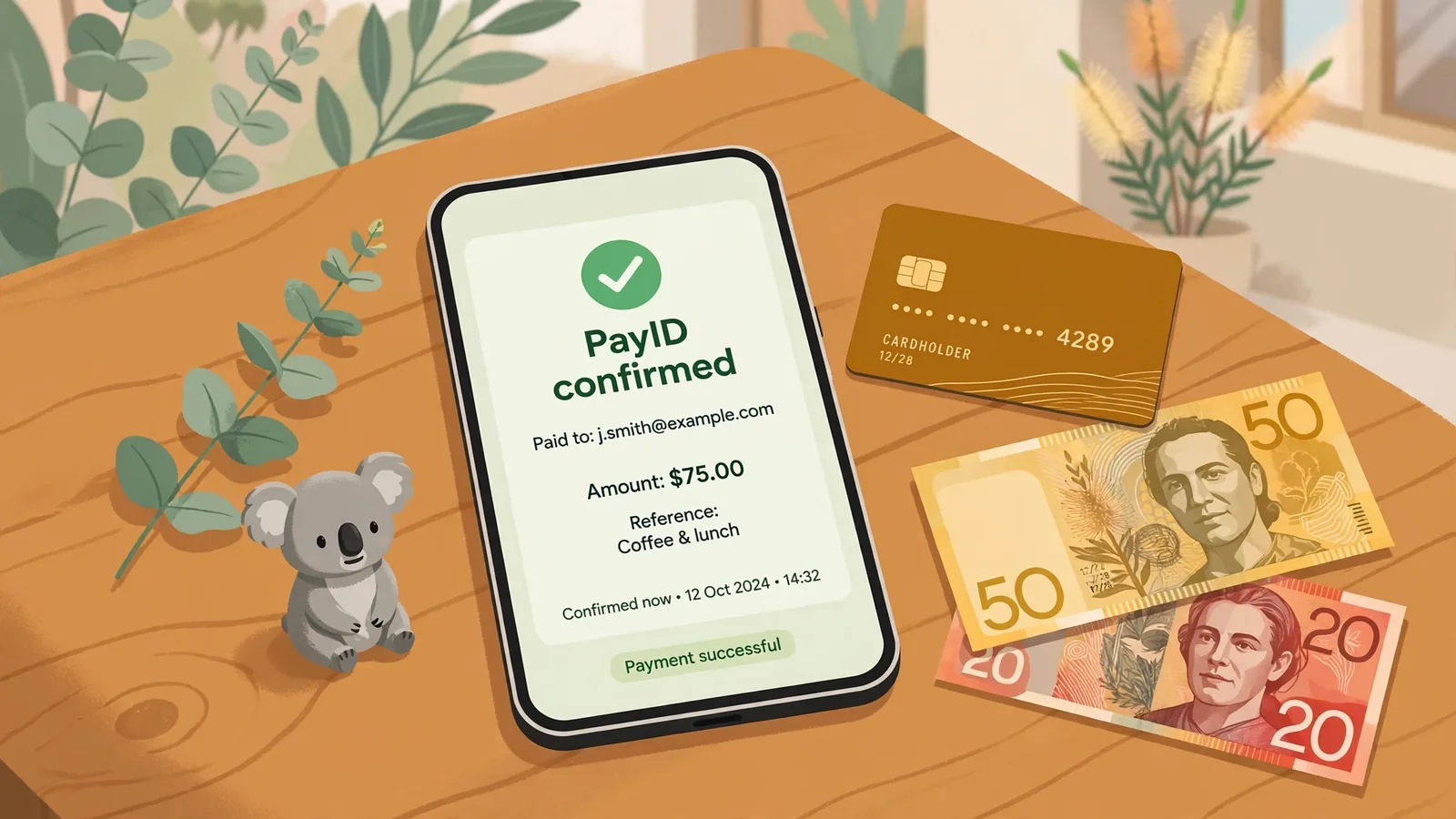
How PayID Fits into Online Pokies Payments
PayID is a digital payment system used in Australia. Instead of entering a bank account number and BSB for each transfer, a payer can use a unique identifier linked to an account, such as a mobile number or email address. The system operates through the New Payments Platform (NPP), which connects participating banks and supports quick transfers between them.
That describes the payment rail, not the service receiving the money. A PayID transfer can move funds between bank accounts, but the availability of PayID does not establish that a recipient is lawful, trustworthy or willing to return funds. The payment method and the business behind a payment are separate matters.
What happens in a payment flow
In a typical online payment flow, a customer selects a payment method in a cashier, enters or confirms the requested details, and authorises a transfer through their bank. With PayID, the identifier is used to direct the payment to the relevant account. The NPP carries the transfer between banks; PayID is the addressing method that helps identify where it should go.
Casinos listed by licence
If you’re looking for new PayID pokies in Australia in 2026, use this list as a starting point and check each casino’s current payment options before signing up. The details below identify what is known about each operator, but do not confirm PayID availability.
-
GoldenCrown
- License
- Curacao Gaming Control Board OGL/2023/176/0095 (Hollycorn N.V.)
You can note GoldenCrown’s stated Curacao Gaming Control Board licence, OGL/2023/176/0095, held by Hollycorn N.V. No payment details are provided here, so PayID availability is unconfirmed.
-
SkyCrown
- License
- Tobique Gaming Commission
- Payout speed
- crypto ~10-15 minutes, fiat 1-5 days
- Min. deposit
- A$30
SkyCrown lists a Tobique Gaming Commission licence, a A$30 minimum deposit, and estimated payout speeds of around 10–15 minutes for crypto and 1–5 days for fiat. PayID availability is not specified.
-
Playfina Casino
- License
- Curacao eGaming (Hollycorn N.V., since 2017)
- Min. deposit
- A$20-30 (depends on the offer)
Playfina Casino lists a Curacao eGaming licence held by Hollycorn N.V. since 2017, with a minimum deposit of A$20–30 depending on the offer; its PayID options are not stated.
-
JustCasino
- License
- Curacao Gaming Control Board
JustCasino’s stated credential is a Curacao Gaming Control Board licence. No deposit, payout, or PayID details are provided.
-
JeetCity Casino
- License
- Curacao eGaming (Dama N.V.)
JeetCity Casino lists a Curacao eGaming licence held by Dama N.V. The available details do not specify its payment methods or PayID availability.
-
DragonSlots Casino
- License
- Curacao Gaming Authority (Jumpman Gaming Ltd)
DragonSlots Casino lists a Curacao Gaming Authority licence held by Jumpman Gaming Ltd. No payment-method details are provided, so you’ll need to check whether PayID is offered.
-
Lucky Dreams
- License
- Curacao
- Min. deposit
- A$20 (POLi)
Lucky Dreams lists a Curacao licence and a A$20 minimum deposit for POLi. The details provided do not confirm whether PayID is also available.
-
SpinsUp
- License
- Curacao Gaming Control Board OGL/2023/174/0082 (Dama N.V.)
SpinsUp lists a Curacao Gaming Control Board licence, OGL/2023/174/0082, held by Dama N.V. No deposit or payment-method information, including PayID, is specified.
-
Wild Tokyo
- License
- Curacao
- Payout speed
- crypto 30-60 minutes, fiat 1-5 days
- Min. deposit
- A$10
Wild Tokyo lists a Curacao licence, a A$10 minimum deposit, and estimated payout speeds of 30–60 minutes for crypto and 1–5 days for fiat. PayID availability is not stated.
-
Vegaz Casino
- License
- Curacao OGL/2024/1335/0780
- Min. deposit
- EUR 20
Vegaz Casino lists a Curacao licence, OGL/2024/1335/0780, and a minimum deposit of EUR 20. The provided details do not confirm PayID support.
If a casino cashier offers PayID for a deposit, it may display a PayID identifier and instructions for making the transfer. The customer then uses their banking service to send the amount requested. Once the transfer is processed, the receiving service can recognise the incoming payment and update its account balance. The exact screens and instructions depend on the bank and the service, so the process is not identical everywhere.
PayID deposits at online casinos are typically completed within seconds. That speed concerns the transfer itself; it does not mean that every other part of an account or transaction is instant. A receiving service may still need to register the payment before showing it in an account, and the time taken for that step is separate from the movement of money through the payment network.
It can help to think of the process in stages: the cashier presents payment instructions, the payer authorises a transfer, banks carry it through the NPP, and the recipient records the funds. PayID is involved in addressing and transferring the payment. It does not operate the recipient’s cashier or decide what happens to an account balance after funds arrive.
The role of the New Payments Platform
The NPP is the infrastructure that enables participating Australian banks to send payments quickly between one another. PayID uses that infrastructure, allowing an identifier such as a phone number or email address to stand in for banking details when directing a payment. The identifier is linked to a bank account; it is not itself a separate account or a stored balance.

This distinction matters when you see PayID described as a payment option. The name refers to a way to address a payment, while the NPP carries it between banks. The cashier or service receiving the money is a separate party. A fast transfer through the NPP does not amount to an endorsement of that party or its activities.
The same basic distinction applies when people discuss new PayID options for online pokies. A recently presented payment route may change how a transfer is addressed or displayed, but the underlying system remains a bank-to-bank payment through the NPP. The word “new” in a cashier description does not, by itself, indicate a new bank service, a change in Australian law, or a new protection for the person paying.
Australia’s legal context
The payment process should not be confused with permission to provide the service being paid for. Under the Interactive Gambling Act 2001, it is unlawful for operators to provide real-money online casino services—including pokies, poker and table games—to people physically located in Australia. These services are treated as prohibited interactive gambling services in this setting.
PayID’s presence in a payment flow does not alter that legal position. It is a payment system, not a licence, approval or sign that a real-money gambling service is permitted to operate for Australian customers. Nor does a completed transfer establish that the recipient will provide the service described or return money later.
This is why the technical explanation is useful but limited. It tells you how an identifier can route a payment and why funds may move quickly between banks. It cannot answer whether a particular service may lawfully accept Australian customers, or whether the service will handle a payment as expected. Those are questions about the recipient, not the NPP.
Legal Notice
Under the Interactive Gambling Act 2001, it is unlawful for operators to provide real-money online casino services to people physically located in Australia.
For anyone encountering a PayID option in connection with online pokies, keep the categories separate: PayID identifies the payment destination, the NPP moves the funds, and the receiving service controls what it records or does next. Understanding that sequence can make the payment screen less confusing, but it should not be mistaken for a reason to make a payment.
Using PayID to Deposit: Details to Check First
Before entering payment details, check that the PayID you intend to use is the one registered with your bank. A phone number or email address entered at a payment screen is not interchangeable with another identifier associated with you: if it does not match your bank’s registered PayID, the payment details may not correspond to your account. Confirm the identifier in your banking settings rather than relying on memory.
Keep the account name consistent as well. The name on your bank account should match the name on the casino profile. A mismatch can create problems when an operator checks payment and account details, including delays or failed transactions. If you have changed your name or opened an account under different details, resolve that discrepancy before relying on the payment information shown in a cashier.
Check the amount against both limits
There are two separate figures to look at before making any payment: the minimum deposit set by the venue and the transfer limit set by your bank. The minimum determines whether the amount is accepted by the cashier. Your bank’s limit determines how much you can send through PayID within its applicable daily allowance. A deposit amount can meet the venue’s minimum but still be too high for your available bank limit.

A specialist review reports that the bank sets the daily PayID transfer limit. Because limits are set by individual banks and may depend on your account settings, check your own banking app or contact your bank for the figure that applies to you. Do not assume that a limit shown by a casino is the same as the limit your bank will permit. If your bank shows a lower available amount, that is the relevant constraint for a transfer from your account.
The deposit minimum is set separately by each operator and may also vary by payment method. Specialist reviews put many PayID minimums in the AU$10–AU$20 range. Treat that as a guide to the range reported, not as a promise that a particular cashier will accept either amount. Read the PayID entry in the cashier and its terms before deciding what amount to enter. If the minimum displayed there is higher than you expected, do not send a smaller payment on the assumption that the cashier will credit it.
When you compare the two limits, make sure you are looking at the PayID option specifically. A venue may show different minimums for different payment methods, and the deposit amount displayed for one method does not establish the requirement for another. Check the amount field and any payment instructions presented for PayID, then compare that figure with the available limit in your own bank account. If the details are unclear, pause rather than guessing.
- Confirm your PayID matches your bank's registered identifier
- Ensure your account name matches your casino profile name
- Check the venue's minimum deposit amount
- Verify your bank's daily PayID transfer limit
Keep the payment details consistent
Check every identifier and account detail before confirming anything. The PayID used for a transfer needs to be registered with your bank, and the account name should align with the casino profile name. Small differences in spelling, an old email address, or a mobile number you no longer use can make it harder to establish that the payment belongs to you. If the bank’s registered details or your profile information are out of date, correct them through the relevant account settings before proceeding.
Also distinguish between details you control and details supplied by a payment page. Your bank controls the PayID registration and transfer limit; the venue controls its deposit minimum and the instructions displayed in its cashier. Check both sides rather than treating a successful-looking payment screen as proof that every requirement has been met. If the cashier’s instructions conflict with what your bank displays, do not improvise or substitute a different identifier.
These checks are practical, but they do not make a real-money casino deposit lawful in Australia. Under the Interactive Gambling Act 2001, operators are prohibited from providing online casino games, including pokies, to people physically located in Australia. The payment information above explains the kinds of account details and limits that may be relevant; it is not an invitation or recommendation to send money to an online casino.
A careful check means confirming your own bank’s registered PayID and limit, ensuring the account name matches the profile name, and reading the PayID-specific minimum shown in the cashier. If any of those details do not line up, do not try to work around the discrepancy by changing the amount or using someone else’s payment details.

PayID in Australia: Bank Restrictions and Irreversible Transfers
A PayID transfer can be quick, but speed does not give you a way to retrieve the money if the payment is sent to the wrong recipient or accepted by a gambling merchant. Two separate issues matter: a bank may stop a transfer before it goes through, while a confirmed transfer cannot be reversed through PayID. Knowing which situation you are dealing with can help you avoid making a second payment in an attempt to fix the first.
There is also an important Australian legal context. Under the Interactive Gambling Act 2001, it is illegal for operators to provide real-money online casino games, including pokies, to people physically located in Australia. A payment option appearing on a cashier page does not change that rule or establish that a service is lawful.
A bank may decline a gambling-related transfer
A specialist review has reported that some Australian banks, including major banks, may sometimes block PayID transfers to gambling merchants they identify. This is not a settled rule that applies to every bank, account or payment. A bank’s position can depend on its acceptable use policies and the circumstances of a transaction, and those policies may change.
If a payment is declined or prevented, do not assume that the problem is a temporary PayID fault. The bank may be applying a restriction to a payment it associates with gambling. The bank is the appropriate place to ask why a transfer was stopped and what its policy permits. A decline does not mean that changing payment details or trying another route is a safe or appropriate solution.
A stopped transaction is different from one that has been confirmed. If the bank has not completed the transfer, the money has not been sent through PayID to the recipient. Check the transaction status in your banking app or contact the bank before doing anything else. In particular, avoid sending another payment while the first one still appears unresolved: that could leave you with two transfers if the original later completes.
Do not share your banking password, one-time security codes or other access details with anyone claiming they can clear a blocked payment. A person receiving money cannot override your bank’s decision, and a request for your account credentials creates a separate risk to your finances.
Confirmation is the point of no return
Once a PayID transaction is confirmed, it is irreversible. PayID does not provide a reversal function that lets you cancel a completed payment because you changed your mind, noticed a mistake or had a later dispute with the recipient. That makes the moment before confirmation especially important: pause and check the payment information shown by your bank rather than relying on what you intended to enter.
If you discover an error after confirmation, contact your bank promptly and explain what happened. The bank can tell you what steps may be available, but you should not treat a recovery as guaranteed. PayID’s irreversible status means that a completed transfer is not simply cancelled on request. Keep the transaction record and any relevant messages so you can describe the issue accurately.
The same caution applies if someone tells you that a payment has not arrived and asks you to send it again. First establish the status of the original transfer with your bank. A recipient’s claim, a screenshot or a message is not a substitute for the status displayed by your financial institution. If you are uncertain whether the transfer completed, do not try to resolve that uncertainty by making another payment.
Do not treat a failed payment as an invitation to bypass a restriction
A bank block is a decision by the institution handling your account, not evidence that a different payment route would be safe. Trying to work around a restriction can expose you to further financial loss and may conflict with the bank’s acceptable use policies. If you need clarity, ask the bank directly rather than following instructions from a merchant or an intermediary.
Be wary of anyone who promises to reverse a confirmed PayID payment for a fee, or asks you to send more money to release or recover it. PayID transfers cannot be reversed once confirmed, and an additional payment does not change that feature. If you believe you have been misled or pressured, contact your bank using its official channels and explain the circumstances.
These cautions are about the transfer itself, not a judgement on whether a payment page is trustworthy. PayID is a payment method; its presence does not establish that an online gambling service is lawful, reliable or willing to return money. In Australia, real-money online casino services are prohibited for operators under the Interactive Gambling Act 2001. A blocked payment and an irreversible one are different problems, but neither should be treated as a reason to keep trying until money moves.
What PayID Can—and Cannot—Offer You
PayID’s practical appeal is straightforward: it lets a person send money using a unique identifier, such as a mobile number or email address, rather than entering a set of bank account details for each transfer. In Australia, the system supports quick transactions between banks. That can make the payment step feel simpler, but it does not change what the payment is for or establish whether a service is lawful.
That distinction matters when the subject is PayID and pokies. Under the Interactive Gambling Act 2001, it is illegal for operators to provide real-money online casino games, including pokies, to people physically located in Australia. A payment method does not alter that legal position. PayID’s availability is a feature of a payment system, not approval of the activity or of a business accepting payments.
A simpler identifier, not a guarantee
A unique identifier can be easier to use than typing bank details into a payment form. It gives the sender a recognisable way to direct a transfer, and PayID is designed for quick transactions. Those are useful properties of the payment method itself. They should not be mistaken for a guarantee about the recipient.
The presence of a PayID option does not prove that a venue is licensed, reliable, fair, or willing to pay out funds. Nor does it confirm that the service is permitted to offer real-money casino games in Australia. A payment interface can tell you which method is offered; it cannot establish the legal status or conduct of the organisation receiving money.
This is an important limit because payment choices can create an impression of legitimacy. A familiar identifier and a smooth transfer may look reassuring, but neither substitutes for evidence about the recipient. PayID processes a transaction; it does not assess the purpose of the payment or certify the business on the other end.
What the fee point means
PayID itself does not charge a transfer fee. Reputable venues also do not add a PayID-specific fee to deposits or withdrawals. That can make the method less costly as a payment rail, but the wording matters: a fee-free transfer is not the same as a fee-free relationship with a service. Other terms or charges may be set by the recipient, so the payment method alone cannot tell you the full cost.
It is also useful to keep the source of any charge clear. PayID’s own fee position relates to the transfer system. A separate charge imposed by a service would be that service’s policy, not a PayID transfer fee. If the price or conditions are unclear, do not assume that the payment method settles the question.
Avoid treating “no PayID fee” as a reason to send money. It describes one narrow feature, not the overall value or safety of a transaction. In particular, a low-friction payment process can make it easier to act quickly. Taking a moment to understand who receives the money and what the transaction means remains important.
PayID Features
Identifier
Uses a mobile number or email instead of bank account numbers.
Speed
Supports quick transfers between participating Australian banks via the NPP.
Cost
PayID itself does not charge a transfer fee.
Convenience has boundaries
A digital payment can be quick and straightforward, yet still leave the key questions unanswered. It cannot establish the recipient’s identity beyond the information presented in the payment process, and it cannot confirm that a service meets standards of fairness or transparency. It also cannot make an otherwise prohibited online casino service lawful for Australian customers.
For that reason, PayID should be assessed as a payment mechanism rather than as an endorsement. If a site presents PayID as evidence that its pokies are safe or approved, that claim goes beyond what the payment method can show. A payment option is not a licence, a regulator’s decision, or a promise about how a business will handle a customer’s funds.
The same caution applies to the phrase “PayID pokies.” It describes a payment arrangement associated with a gambling service; it does not describe a separate legal category or a special protection for the person sending money. The system’s speed and identifier-based design do not change the rules that apply to real-money online casino games in Australia.
So the useful value is limited but clear: PayID offers a distinct identifier for making transfers, and PayID itself does not levy a transfer fee. Those features may simplify the mechanics of a payment. They do not verify a gambling operator, remove other possible charges, or resolve whether the underlying service can lawfully be offered to someone in Australia. When a payment method is presented as proof of more than that, treat the claim with care.

Checks to Make Before Considering a PayID Venue
A PayID logo or payment option is not evidence that a venue is lawful, trustworthy or willing to pay out. In Australia, the Interactive Gambling Act 2001 prohibits operators from providing real-money online casino games, including pokies, to people physically in the country. A foreign licence does not change that position. This makes it important to separate checking what a website claims from treating it as a suitable place to play.
If you encounter a site presenting itself as an Australian PayID pokies venue, approach its claims cautiously. A polished cashier page, familiar payment method or promotional offer cannot establish that the service is lawful in Australia. Do not treat a payment option as an endorsement or recommendation.
Check what the cashier actually lists
Before creating an account or sharing personal or financial details, look at the cashier page and confirm whether PayID is listed as a payment option. A logo elsewhere on the site, or a general claim that PayID is accepted, may not match the options currently available to customers. The cashier page is where the site describes its payment methods.
Check that the details are clear and consistent: the payment method should be named, and the site should explain how it expects a customer to use it. If the payment instructions are vague, conflict with other pages, or require you to send funds in a way that differs from what the cashier describes, do not guess. A payment method being available does not verify the operator behind it.
This check is about confirming the site’s own stated payment arrangements, not deciding that a venue is safe. PayID access does not establish licensing, game fairness, transparent return-to-player information or a willingness to release winnings. Those are separate matters, and a payment page cannot answer them.
Verifying Licences
Even if a site displays an overseas licence, it does not grant the operator permission to provide real-money gambling services to people located in Australia.
Understand what a licence claim means in Australia
Read any licensing statement carefully and identify which regulator is said to have issued the licence. If a site names an overseas regulator, look for the regulator’s public register and check whether the operator’s legal name and licence details appear there. A logo or certificate displayed on the site is not the same as an independent public record.
Even if an overseas licence can be verified, it does not authorise the operator to provide real-money online casino games to people in Australia. The Australian legal position is different: the Interactive Gambling Act 2001 prohibits operators from offering these services to people physically located here. Do not mistake an overseas licence for Australian approval or for evidence that a site is lawful to use from Australia.
If the operator’s identity is unclear, the licence cannot be found in a regulator’s public information, or the details do not match, treat that as a reason to stop rather than a minor paperwork issue. Public verification can help establish what a licence claim says; it cannot remove the Australian restriction.
Read bonus terms before accepting an offer
A bonus is an offer with conditions, not automatically withdrawable money. Before accepting one, read the complete terms, including any wagering requirement, eligible games, expiry conditions, withdrawal rules and maximum bet while the bonus is active. If the terms are difficult to find or leave important conditions unclear, do not accept the offer on the assumption that you can resolve it later.
A specialist casino review describes wagering requirements of 30x–45x the bonus amount as common, but that range should not be treated as a rule for every offer. The terms attached to the specific promotion are what matter. Check how the operator defines the wagering calculation and which funds or winnings it applies to; wording can change the practical value of an offer considerably.
Pay particular attention to the maximum permitted bet during bonus wagering. If you exceed that limit, the operator may void the bonus and associated winnings. A small misunderstanding about a bet limit can therefore affect more than the promotional credit itself. If the limit or its consequences are not stated plainly, declining the offer is safer than relying on an interpretation that the operator may not share.
A careful review can help you recognise what a site claims and where its terms are unclear. It cannot turn an offshore real-money casino into a lawful Australian service, and PayID availability should never be taken as proof that it does.
PayID Withdrawals: Pending Periods, Minimums and Fees
A PayID withdrawal can take longer than a deposit because the money does not necessarily move as soon as you submit a request. A deposit may be completed within seconds, but a withdrawal can first sit in the casino’s system while the operator checks the request. Only after approval is the payment sent through PayID to the nominated account. These are separate stages, so a quick bank transfer does not remove the time spent waiting for the casino’s decision.
Withdrawal Information
Why is my withdrawal pending?
An operator may perform internal reviews or identity checks before approving a request to release funds.
How long do PayID withdrawals take?
After approval, transfers may take 12–24 hours, with the total process potentially reaching 2–4 days.
Are there withdrawal fees?
While PayID does not charge a fee, some operators may deduct a fee or a specific amount for small withdrawals.
This distinction matters when you are trying to understand a delay. A request marked as pending has not necessarily been sent to your bank. It may still be undergoing an internal review, or it may be within the operator’s stated waiting period before release. Once the casino approves and dispatches it, the bank-transfer stage begins. Check the withdrawal status and the operator’s payment terms before treating a pending request as a failed transfer.
The review comes before the transfer
Casino-initiated PayID withdrawals may have an internal pending period. One specialist review describes a period of 24–72 hours before funds leave the casino’s system; that is a reported practice, not a timetable you can assume applies to every operator. The operator’s own rules determine whether a request is held for review and how long that stage may take.
Internal checks can include confirming account details and reviewing identity documents. Specialist reviews report that payout speed can depend on the casino’s review process and on whether the player’s identity checks, often referred to as KYC, are complete. If the operator asks for documents or clarification, the request may remain unapproved until the checks are resolved. Submitting the requested information promptly may help avoid an additional hold, but it cannot guarantee a particular release time.

After approval, the transfer itself is a different step. Specialist reviews report that PayID withdrawals can take 12–24 hours after approval, while the complete interval from request to receipt may reach 2–4 days when an internal pending period is included. Treat these as reported timeframes rather than promises: the operator’s process and the point at which it sends the payment affect the total wait. If a stated period has passed, contact the operator through its support channel and ask whether the withdrawal is still under review or has been sent.
Minimum withdrawal amounts
The minimum amount you can request is set by the operator, not by PayID. Specialist reviews place typical PayID withdrawal minimums in the AUD 20–50 range, but the amount applying to a particular account may differ. Look for the withdrawal rules in the cashier or payment terms and confirm the minimum before submitting a request. If your balance is below that threshold, the system may not accept the withdrawal.
A minimum is not the same as a fee. The minimum determines the smallest request the operator will process; a fee reduces the amount you receive or is charged separately. Read the rules for both, and check whether any conditions apply to small withdrawals. That way, the amount shown when you submit a request is less likely to come as a surprise when the payment arrives.
Possible withdrawal charges
PayID itself does not charge a transfer fee. However, that does not rule out a charge imposed by an operator. Specialist reviews report that some casinos charge AUD 2–5 per withdrawal. They also describe cases where A$5–A$10 may be deducted from withdrawals below an operator’s internal threshold, with A$100 or A$200 cited as examples of such thresholds. These are reported conditions, not universal charges. The relevant terms should state whether a fee applies, how it is calculated and whether it is taken from the payout.
Before confirming a request, compare the requested amount with the amount the operator says it will send. If a fee or deduction is unclear, ask for the applicable rule in writing before proceeding. Keep a record of the request, its status and any response from support; those details can help you follow up if the amount received differs from what was shown.
Australia’s Interactive Gambling Act 2001 prohibits operators from providing real-money online casino games, including pokies, to people physically located in Australia. Payment processing does not change that legal position. This information explains reported withdrawal mechanics; it is not a recommendation to use an online casino service.
For any withdrawal already in progress, the useful questions are straightforward: has the operator approved it, has it actually sent the PayID transfer, and what minimum or fee rule applies? Separating those points helps you identify where a delay or deduction arose without assuming that every stage follows the same schedule.
Does PayID charge fees for casino deposits or withdrawals?
PayID itself does not charge transfer fees, but some casinos may charge A$2–A$5 per withdrawal or deduct A$5–A$10 from withdrawals below their thresholds.
How do you deposit money into online casino sites using PayID?
Select PayID in the cashier, check the payment identifier and instructions, then authorise the transfer through your bank. Deposits typically reach the receiving service within seconds, though it may take additional time to appear in your account.
What is the key benefit of using PayID pokies?
PayID lets you direct a bank transfer using an identifier such as a phone number or email instead of entering bank account and BSB details. Transfers typically complete within seconds.
Can you withdraw casino winnings using PayID?
Yes, PayID supports withdrawals. After the casino approves a withdrawal, the transfer usually reaches your account within the same day, although internal reviews and pending periods can extend the total wait.
Is it legal to play Pokies games with PayID in Australia?
No. Real-money online casino services, including pokies, are unlawful for operators to provide to people physically located in Australia; using PayID does not change that.
Do online casino sites in Australia use PayID?
Yes, some online casino sites offer PayID for deposits. Its availability does not mean the service is lawful or endorsed.
How long do PayID withdrawals take?
After approval, PayID transfers usually arrive within the same day, typically within 12–24 hours. Casino review and pending periods can make the total time from request to receipt usually 2–4 days.