Millioner Casino Reputation and Complaints
 Available in US
Content
As of 9 September 2026, Millioner’s Trustpilot profile shows a 1.7 TrustScore from 118 reviews, with 75% of ratings at one star. Casino Guru’s more recent review surface reports a below-average Safety Index of 5.6 and says its complaint data currently includes 2 complaints directly about Millioner plus 6 complaints about related casinos. The visible complaint themes include delayed withdrawals, account-closure or self-exclusion disputes, confiscated deposits and account closures. These are reputation signals, not proof that every user allegation is true. The strongest way to use them is to compare recurring themes with Millioner’s current official terms. Those terms do publish a withdrawal review timetable, allow KYC and source-of-funds checks, and set account and self-exclusion procedures. Review scores, complaint reports and official terms should be weighed separately rather than collapsed into a single label such as scam, safe or unsafe.
Dated reputation snapshot
Reputation metrics change, so the date matters. On 9 September 2026, Trustpilot’s millioner.com profile shows 118 reviews and a 1.7 TrustScore. The distribution shown on the profile is heavily negative: 75% one-star, 7% two-star, 3% three-star, 2% four-star and 13% five-star. Trustpilot also labels the profile unclaimed and notes that the company has not invited its customers to review.
Those numbers describe the review population on Trustpilot, not the whole customer base. Trustpilot itself notes that reviews are individual opinions and may not be representative. A low aggregate score is therefore a reason to investigate the recurring subjects in the reviews, not a mathematical proof that a specific future withdrawal will fail.
Casino Guru uses a different methodology. Its current Millioner review shows a Safety Index of 5.6, labelled below average, and separately tracks complaints, terms, related casinos and other factors. Because the two services measure different things, their numbers should not be combined into a single synthetic “trust score”.
Complaint themes visible in current third-party data
The useful part of complaint data is identifying recurring patterns. Current Trustpilot reviews repeatedly discuss payout delays, cancelled or pending withdrawals, limited progress information from support and account-access issues. Some reviewers use highly charged words such as “scam” or “fraud”. Those labels remain individual reviewers’ allegations rather than established facts.
Casino Guru’s current complaint surface also includes withdrawal-delay cases and account or self-exclusion disputes. Its review summary reports 2 complaints directly about Millioner and 6 involving related casinos, while its broader complaint metrics list opened, unresolved, resolved and rejected cases across the dataset used in its methodology. One 2026 case about a self-exclusion and refund dispute was closed as unresolved after Casino Guru said the casino did not cooperate with its process. That is a documented outcome within Casino Guru’s complaint system, not a regulator ruling or court finding.
Across the two platforms, four recurring categories are more informative than individual accusations:
- Withdrawal timing: users report payouts remaining pending longer than expected.
- Communication quality: some reviews describe repeated generic responses or unclear timelines.
- Account access and closure: complaints include blocked access, account closure and disputes about whether closure requests were honoured.
- Verification or terms enforcement: some disputes involve operator checks, confiscation claims or disagreement about the application of rules.
These themes help a prospective user know what to document and what terms to read. They do not establish that every case has the same cause.
Official terms and published rules
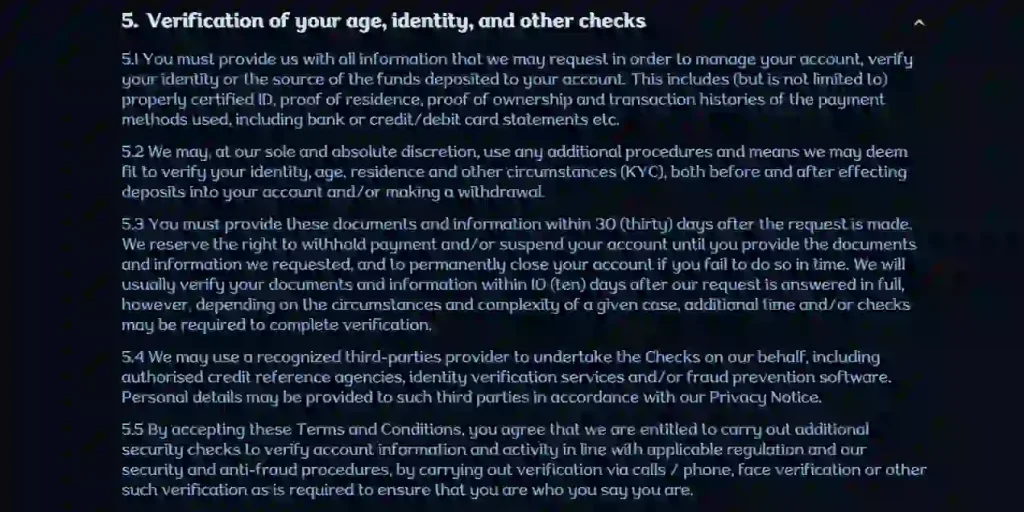
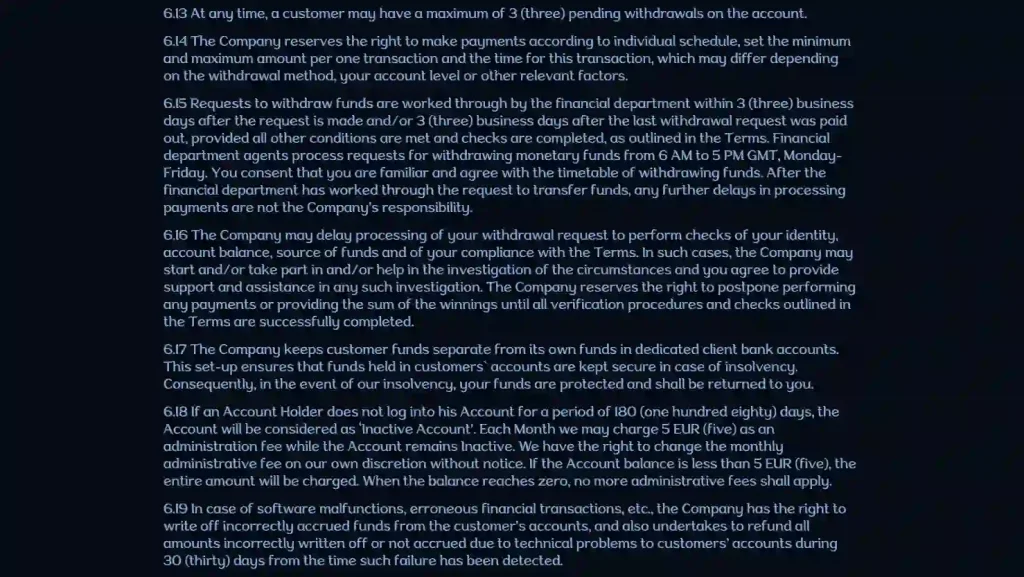
Official terms are the strongest source for what Millioner says its process is supposed to be. The current General Terms are Version 1.11, last updated 17 June 2026. They say withdrawal requests are worked through by the financial department within 3 business days after the request is made, or within 3 business days after the last withdrawal request was paid, provided the other conditions are met and checks are completed. The terms also say further delays after the finance department has processed the transfer can fall outside the company’s responsibility.
The same terms explicitly allow Millioner to delay a withdrawal for identity, account-balance, source-of-funds and compliance checks. KYC provisions allow requests for certified ID, proof of residence, proof of payment-method ownership and transaction histories. Customers are given 30 days to provide requested information, and the terms say documents are usually verified within 10 days after the request is answered in full, with additional time possible for more complex cases.
These clauses do not prove that every reported delay was justified. They do explain why a complaint about a payout taking longer than three business days cannot be evaluated from the elapsed time alone. The factual question is whether the finance review was still pending, KYC was incomplete, another check had been triggered, or the request had already been processed and was delayed elsewhere. The Millioner withdrawals maps those stages in detail.
Aggregate review metrics
An aggregate rating can show sentiment concentration. Trustpilot’s current 1.7 score and one-star majority are significant because they show that the visible review population is predominantly dissatisfied. At the same time, aggregate ratings have limitations: reviewers self-select, a single person can only describe their own account, and the platform does not independently adjudicate the underlying casino transaction in the way a regulator or court might.
That means the responsible use of the metric is descriptive. It is accurate to say the current profile is strongly negative. It is not accurate to convert that into a verified claim that Millioner never pays withdrawals, deliberately steals customer funds or will treat every Australian user the same way.
Positive reviews should be handled with the same caution. A good experience with support or a completed withdrawal is evidence of that reviewer’s reported experience, not proof that there are no systemic problems. Reputation analysis becomes stronger when it looks for repeated categories and then tests those categories against observable operator rules.
Complaint cases and resolution status
A complaint case can contain more detail than a star rating because it often includes a timeline, disputed amount, operator correspondence and the complaint site’s resolution status. Casino Guru’s visible cases currently span delayed withdrawals, deposit confiscation, account closure, self-exclusion and refund disputes. Its methodology also distinguishes resolved, rejected, unresolved and still-open cases.
The resolution label is useful within that platform’s process. For example, an unresolved case can show that Casino Guru did not reach a satisfactory resolution. It still should not be rewritten as a legal judgment. The complaint platform is not ACMA, an Australian licensing authority or a court.
This matters particularly for self-exclusion complaints. Millioner’s own General Terms say customers can request self-exclusion by email and should notify the company of other accounts. A user allegation that a closure or exclusion failed is therefore relevant to reputation because it touches an express operator process. It remains an allegation until supported by stronger independent evidence. For the account and verification rules themselves, use the Millioner KYC and the official terms rather than relying on complaint summaries.
What the current withdrawal complaints mean for an Australian reader
The most practical takeaway from repeated payout complaints is documentation discipline. Before depositing, read the current withdrawal limits and KYC rules. If you later request a payout, keep the timestamp of the request, the amount, the displayed status and every verification message. If documents are requested, record when Millioner considers the response complete. If the status changes or a withdrawal is cancelled, keep a record and ask support for the specific rule or check involved.
This creates a factual timeline that can be compared with the published terms. A bare statement that a payment is “late” is less useful than a record showing the request date, KYC completion date, finance-review status, any cancellation and the support response. If a dispute later needs to be described to a complaint platform, those records reduce ambiguity.
Australian readers should also keep the regulatory context separate from the reputation issue. No Australian local licence was verified for Millioner, and ACMA says online casinos are a prohibited service category for providers offering them to people in Australia. The Millioner licence in Australia explains why Australian regulatory protection should not be inferred from the site’s accessibility or localisation.
Why licensing claims are not used to settle the reputation question
Third-party casino review sites make claims about Millioner’s corporate ownership and licensing status, but the available foreign-licence details are conflicting or lack direct regulator confirmation. They should therefore not be treated as settled facts. The Australian local-licence question is clearer: as of 9 September 2026, ACMA’s licensed interactive wagering register did not list Millioner.
That separation protects the reputation analysis from two common errors. First, a licence logo or third-party licence assertion should not automatically erase complaint patterns. Second, a low review score should not be used as proof that a particular licence claim is false. Licensing and reputation require different evidence.
How to read “legit”, “safe” and “scam” claims
Searches for casino reputation often use binary words, but the evidence rarely fits a binary answer. “Legit” can mean the website is real, the games load, the operator pays some users, the company has a licence somewhere, or the service is authorised in the reader’s jurisdiction. Those are different propositions. “Safe” can refer to payment security, game integrity, responsible gambling, regulatory recourse or simply a reviewer’s personal result.
“Scam” is even more serious. Individual reviewers use that word on Trustpilot, but it should not be treated as an established description of Millioner. A fairer reading is that the current independent reputation signals are materially negative, especially around withdrawals and communication, and that those signals deserve weight alongside the operator’s published terms and the unresolved foreign-licence picture.
Practical reputation checklist
- Check the date of every aggregate rating because review counts and scores change.
- Separate first-person allegations from platform resolution outcomes and official rules.
- Look for recurring complaint categories instead of treating the most dramatic review as representative.
- Compare withdrawal complaints with the current finance and KYC terms before deciding what a delay means.
- Keep saved records and timestamps for account, KYC and payout events if you use the service.
- Do not assume Australian regulatory protection from an Australia-facing URL or AUD support.
For a broader product-level assessment, the Millioner Australia review covers games, payments, bonuses, mobile use and account requirements. The reputation section focuses on complaint patterns, aggregate sentiment and how those signals compare with official terms.
Reputation takeaway
Millioner’s current third-party reputation is weak. Trustpilot shows a 1.7 TrustScore from 118 reviews, with three quarters of ratings at one star, while Casino Guru currently assigns a below-average Safety Index and tracks active complaint data involving withdrawal and account-control issues. Those signals are relevant but not self-proving. Official terms confirm that payouts can depend on finance review and KYC, and they publish specific procedures that should be checked against any individual dispute. The most defensible reading is evidence-based rather than binary: current independent sentiment is strongly negative, complaint patterns deserve caution, and individual allegations should remain clearly distinguished from verified operator terms or regulator findings.
This material was created by the Millioner Australia Guide team.
Related posts
Millioner Withdrawals: Limits, Times and Verification

Millioner Live Casino Review