
Millioner KYC and Verification Guide
 Available in US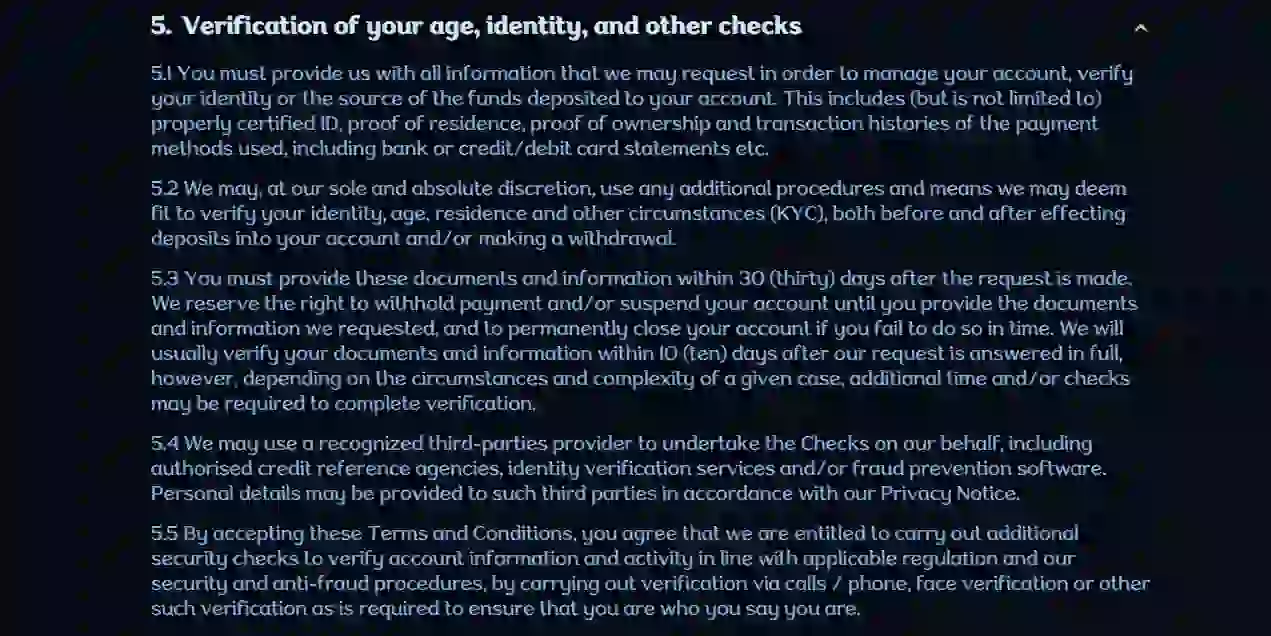
Content
Millioner’s current General Terms say the operator can ask for information and documents to verify identity, age, residence, payment-method ownership and source of funds. The examples expressly include properly certified ID, proof of residence, and evidence connected with the payment methods used, including ownership and transaction histories such as bank or card statements. The terms give a customer 30 days to provide requested material. Once a request has been answered in full, Millioner says verification is usually completed within 10 days, although a more complex case can require additional checks and more time. Verification can be requested before or after deposits and before a withdrawal, so KYC is best treated as a direct account and payout dependency rather than an optional step that matters only after a problem occurs.
What Millioner can ask you to verify
The official verification section is broad. It allows Millioner to request information needed to manage the account, verify identity, or establish the source of deposited funds. Its examples include properly certified identification, proof of residence, proof that the customer owns the payment method, and transaction histories for payment methods used on the account. Bank and credit or debit card statements are named as examples of payment evidence.
That wording matters because there is no single fixed document pack that every customer can assume will be sufficient in every case. A passport or driving licence can address identity, but it does not necessarily establish current residence or ownership of a particular card or bank account. Likewise, a bank statement may help with address or payment history while still leaving a separate identity check outstanding.
The terms also allow Millioner to verify age, residence and other circumstances through additional KYC procedures. The operator may use third-party verification providers, authorised credit reference agencies, identity-verification services or fraud-prevention software, and it may carry out additional security checks such as phone or face verification when required by its procedures.
Document checklist from the current terms
Start with the document categories that Millioner names in its current terms.
- Identity: properly certified identification may be requested to establish who controls the account and to check age.
- Residence: proof of residence may be requested to confirm the address and jurisdiction attached to the account.
- Payment-method ownership: evidence may be requested to show that the card, bank account or other funding method belongs to the account holder.
- Transaction history: Millioner can request payment-method histories, including bank or card statements, as part of verification.
- Source of funds: the verification clause permits requests for information needed to establish the source of funds deposited to the account.
This list describes what the published terms allow Millioner to request. It is not a promise that every customer will be asked for all five categories, nor is it a complete prediction of every document that might be accepted in an individual case.
When verification can happen
Millioner says KYC can be carried out both before and after deposits and in connection with a withdrawal. That creates several possible trigger points. A new account can be checked early, a payment can create a need to establish ownership or source of funds, or a withdrawal can remain pending while identity and account checks are completed.
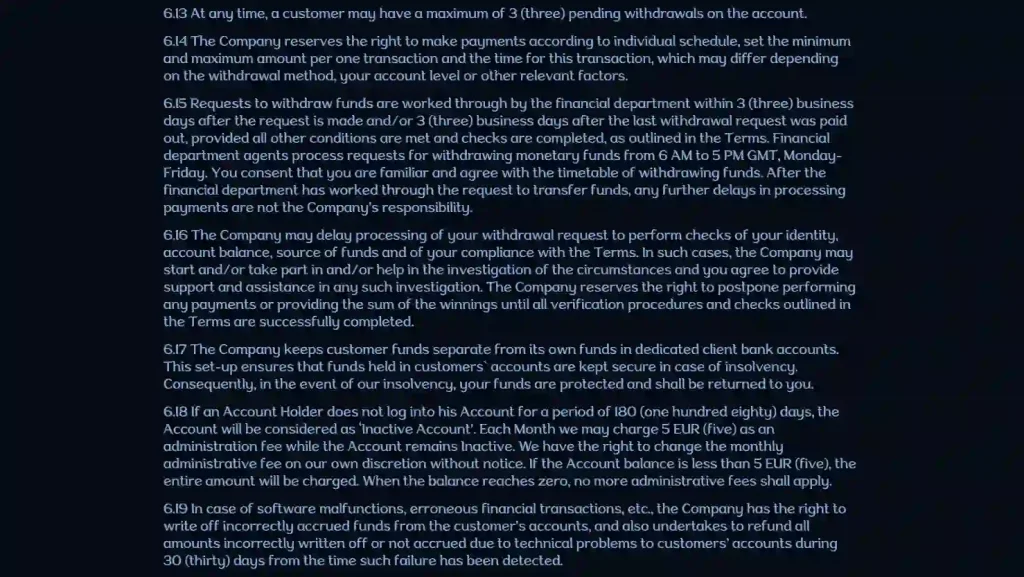
The withdrawal connection is especially important. The terms permit Millioner to withhold payment or suspend an account while requested documents and information remain outstanding. They also reserve the right to postpone payments until verification procedures and other checks are successfully completed. A player therefore should not assume that submitting a withdrawal automatically starts an unconditional payout clock.
For the published withdrawal timetable and AUD limits, see the Millioner withdrawals section. Verification can pause or extend the finance process, so KYC status and payout processing should be tracked separately.
The 30-day response period
The current terms state that requested documents and information must be provided within 30 days after Millioner makes the request. That is a deadline for the customer to respond, not a 30-day promise for Millioner to finish verification. Missing the response period can have serious account consequences because the operator reserves the right to withhold payment, suspend the account and ultimately close it if the requested material is not supplied in time.
In practice, the safest approach is to read the request carefully and answer the complete request rather than uploading one document at a time without checking what each item is meant to prove. If the request asks for identity, address and ownership of a payment method, supplying only an ID can leave the request incomplete and delay the point from which the usual verification timing becomes relevant.
How to read the usual 10-day timing
Millioner’s terms say documents and information are usually verified within 10 days after the request is answered in full. The wording includes two important limitations. First, the period starts after a complete response, not necessarily when the first file is uploaded. Second, the terms state that additional time or checks may be required depending on the circumstances and complexity of the case.
That means the 10-day statement should be used as a published usual verification period, not as a guaranteed maximum. A mismatched address, unclear image, payment method held in a different name, source-of-funds question or additional security check can create another step before the review is complete.
If support asks for more information, keep the message that identifies the new request and the date on which you answered it. A clear record makes it easier to tell whether the case is waiting for customer action or still being reviewed by the operator.
How to reduce avoidable KYC delays
Most preparation is basic data consistency rather than technical document work. The account name should match the identity document. The residential address entered during registration should be current and should match the evidence supplied when address proof is requested. If a payment method is in the account holder’s name, the ownership evidence should make that relationship clear without exposing unrelated information unnecessarily.
- Use clear, readable images or documents with the requested edges and details visible.
- Check that names, dates and addresses are consistent across the account and supporting evidence.
- Answer every requested category in one organised response where possible.
- Do not edit a document in a way that changes its meaning or hides information Millioner specifically asked to verify.
- Keep copies of the request, submission date and any follow-up messages.
These steps cannot guarantee approval or a particular completion time. They simply reduce avoidable friction caused by unreadable files or inconsistent account data.
Payment-method verification is not the same as a deposit check
A payment going through successfully does not by itself prove that all later ownership checks are complete. Millioner’s terms separately allow the operator to request proof of ownership and transaction history for the methods used. A card, bank account or other method can therefore work for funding while still generating an evidence request before a withdrawal.
This is why payment choice should be considered together with verification. The Millioner payments guide covers the broader AUD and method context, while KYC focuses on whether the operator can establish that the funding route belongs to the account holder and fits the account activity.
Registration accuracy matters before KYC begins
Millioner’s account rules require registration data to be true and complete and require customers to keep account details up to date. That makes the registration stage the first piece of verification preparation. Incorrect spelling, an old address or information that does not match later documents can create questions that would not exist if the account record were accurate from the beginning.
The Millioner registration explains the account setup rules and the one-account requirement. KYC is the follow-on process that tests whether the information and payment activity can be supported when Millioner asks for evidence.
Australian context and what KYC does not prove
Completing Millioner’s KYC process does not establish that the operator holds an Australian gambling licence or that Australian regulatory protections apply to the account. Identity verification is an operator account-control process. Licensing and Australian legal context are separate questions and should not be inferred from successful verification, AUD support or an Australia-targeted web page.
For that distinction, see the Millioner licence in Australia. Keeping these topics separate avoids a common mistake: treating a stringent KYC process as evidence of local regulatory authorisation.
What to do if verification is holding a withdrawal
For the broader product, payments and Australian context, the Millioner Australia review provides the brand-level overview.
Start by identifying whether Millioner considers the document request complete. Ask whether any identity, residence, payment-method or source-of-funds item is still outstanding. If nothing is missing, record the date on which the request was answered in full, because that date is the relevant reference point for the terms’ usual 10-day verification statement.
Next, keep verification and finance processing as separate stages. A completed KYC review does not necessarily mean the external payment has already settled, while a pending finance review does not necessarily mean KYC has failed. The withdrawal limits and times guide explains the later payout process.
A simple timeline is useful: request received, documents submitted, any follow-up request, date of complete response, verification status, withdrawal status and support replies. This gives a factual basis for escalation without guessing about the cause of a delay.
KYC takeaway
Millioner’s current terms support a clear operational summary: verification can cover identity, age, residence, payment-method ownership, transaction history and source of funds; requested material must be supplied within 30 days; and verification is usually completed within 10 days after a complete response, with extra time possible for more complex cases. Because outstanding checks can hold a withdrawal, preparing accurate account data and responding to the full request is more useful than trying to predict a universal document pack.
This material was created by the Millioner Australia Guide team.
Related posts

Millioner Casino Reputation and Complaints
Millioner Withdrawals: Limits, Times and Verification