
Separate venue facts from promotional claims
The phrase is informal, while casino status depends on the licence issued in the state or territory where a property is located.
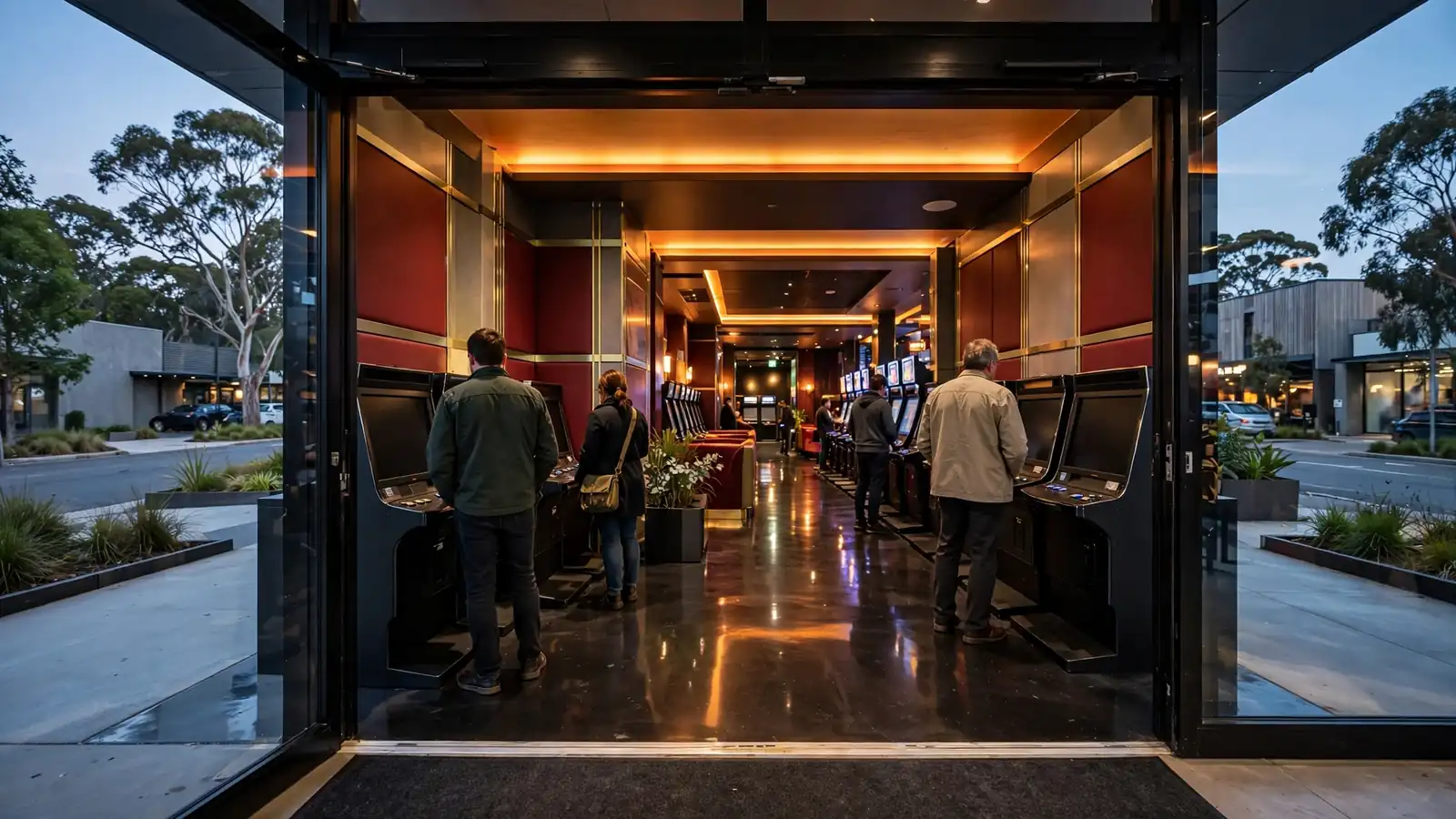
What “Pokies Parlour” Means in Australia
“Pokies parlour” is an informal phrase, not the name of a distinct Australian casino licence or a single venue operator. In ordinary use, it points towards a place associated with pokies, or towards a casino that offers them. The wording can be imprecise: it does not, by itself, tell you whether a particular place is a casino, who operates it, or what legal status it has.
The key distinction is between a descriptive phrase and a regulated property. Australia’s casino industry is overseen by state and territory jurisdictions. Each casino property operates under a licence issued by the jurisdiction where it is located. So, when you see a venue described as a casino, its relevant licence belongs to that local regulatory framework—not to a separate national category called a “parlour casino.”
The word “parlour” can make a place sound like a small, standalone room or a special kind of gaming venue. That impression is not enough to identify what the property actually is. A business might use the word informally in its description, or a writer might use it loosely, without that wording establishing a licence or defining the venue’s regulatory category. Treat the name as a clue to what someone means, not proof of the venue’s status.
Casinos listed by licence
If you’re looking at online pokies options in Australia for 2026, licensing and practical payment details can help you assess what each listing tells you. Use the information below as a starting point and check the terms that apply to you.
-
GoldenCrown
- License
- Curacao Gaming Control Board OGL/2023/176/0095 (Hollycorn N.V.)
GoldenCrown is listed with a Curacao Gaming Control Board licence, OGL/2023/176/0095, held by Hollycorn N.V.
-
SkyCrown
- License
- Tobique Gaming Commission
- Payout speed
- crypto ~10-15 minutes, fiat 1-5 days
- Min. deposit
- A$30
SkyCrown lists the Tobique Gaming Commission as its licence authority. You can deposit from A$30; stated payout times are around 10–15 minutes for crypto and 1–5 days for fiat.
-
Playfina Casino
- License
- Curacao eGaming (Hollycorn N.V., since 2017)
- Min. deposit
- A$20-30 (depends on the offer)
Playfina Casino is listed as licensed by Curacao eGaming through Hollycorn N.V., with that licensing relationship dating to 2017. Your minimum deposit is A$20–30, depending on the offer.
-
JustCasino
- License
- Curacao Gaming Control Board
JustCasino is listed with a Curacao Gaming Control Board licence.
-
JeetCity Casino
- License
- Curacao eGaming (Dama N.V.)
JeetCity Casino is listed as licensed by Curacao eGaming through Dama N.V.
-
DragonSlots Casino
- License
- Curacao Gaming Authority (Jumpman Gaming Ltd)
DragonSlots Casino is listed with a Curacao Gaming Authority licence held by Jumpman Gaming Ltd.
-
Lucky Dreams
- License
- Curacao
- Min. deposit
- A$20 (POLi)
Lucky Dreams is listed as licensed in Curacao. If you deposit using POLi, the stated minimum is A$20.
-
SpinsUp
- License
- Curacao Gaming Control Board OGL/2023/174/0082 (Dama N.V.)
SpinsUp is listed with a Curacao Gaming Control Board licence, OGL/2023/174/0082, held by Dama N.V.
-
Wild Tokyo
- License
- Curacao
- Payout speed
- crypto 30-60 minutes, fiat 1-5 days
- Min. deposit
- A$10
Wild Tokyo is listed as licensed in Curacao. The stated minimum deposit is A$10, and payout times are 30–60 minutes for crypto and 1–5 days for fiat.
-
Vegaz Casino
- License
- Curacao OGL/2024/1335/0780
- Min. deposit
- EUR 20
Vegaz Casino is listed with Curacao licence OGL/2024/1335/0780. Its stated minimum deposit is EUR 20.
This matters because Australian gaming venues are not all interchangeable. A casino property and another kind of venue may be subject to different local arrangements. The phrase “pokie parlour” does not settle that question. Nor does adding “casino” to the phrase make a venue licensed: the relevant details are those attached to the property and its local jurisdiction.
A specialist review describes Australia as having more than 20 full-scale casinos across all eight states. That is a dated, changeable market description, rather than a permanent definition of what counts as a casino. It also does not mean that every place described online as a parlour is one of those casinos. The wording may refer to a broad idea, while the underlying business and its status need to be understood on their own terms.
When you encounter the phrase, separate three things: the language being used, the kind of place being described, and the property’s regulatory position. The first may be casual or promotional. The second may refer to a physical gaming venue or to a casino. The third depends on the licence issued by the relevant state or territory. Combining them into one label can create false certainty.
For example, a page title or directory entry might use “pokies parlour casino” because the terms are commonly associated in people’s minds. That combination does not establish that the venue has a special parlour licence, that it is part of a particular chain, or that the description is an official classification. It is safer to read the words as a broad description until the specific property and its jurisdiction are clear.

The same care applies when “parlour” is used as though it were a formal venue type. Unless a local authority’s information identifies a legal category by that name, the label should not be treated as a substitute for the actual licensing arrangement. Australia’s system is jurisdiction-based, so a general phrase cannot answer every property-level question across the country.
In short, the expression is useful for understanding what someone may be referring to, but it is not a reliable legal label. In Australia, a casino is defined by its property and the licence issued in its state or territory. “Pokies parlour” may describe the idea in everyday language; it does not create a new class of casino or identify an operator on its own.
Finding Casino Venues and Checking Access Details
A venue search can cover a wide area, so start with the city or region you plan to visit rather than assuming every result is a casino. Australia’s gambling venues are spread across its states and territories, but counts compiled by specialist casino-location reviews are snapshots, not a permanent register. One such review reports gambling facilities in 147 Australian cities and identifies Sydney, New South Wales, as the largest gambling city, with 11 facilities. Treat those figures as a guide to the review’s coverage, not as a guarantee that every listed location is a full-scale casino or is still operating.
The same care applies when comparing regions. A specialist location review reports three casinos across three cities in the Northern Territory. That description gives a broad sense of the distribution, but it does not tell you whether a venue suits your plans or whether its details have changed. Check the individual property’s information before travelling, especially if you are relying on a particular entrance, address or facility.
For a concrete address, Lasseters Casino is listed at 93 Barrett Drive, Alice Springs, NT 0870, Australia. Compare the full address with the venue’s own directions before setting out. A map result can be useful for orientation, but it may not answer practical questions such as which entrance to use, whether a particular area is accessible to visitors, or whether construction has affected access. If the address or directions conflict across listings, contact the venue rather than guessing.
Before a visit, confirm the property’s name and location through its official information, then check the details that matter to you: how to reach the entrance, available transport or parking information, accessibility arrangements, and any conditions for entering the areas you intend to visit. Do not assume that a general listing describes every part of a property. A casino may sit within a larger complex, and a result for the complex can be less precise than the casino’s own visitor information.

Bring valid photo identification. Major Australian casinos require it for entry, so checking that your identification is current and available can prevent an avoidable problem at the door. If you are travelling with someone who may not enter a gaming area, check the venue’s information about access to other facilities separately; permissions for one part of a complex should not be taken to apply everywhere.
Finally, check details close to the day of your visit. Venue listings and local arrangements can change, while a location count or directory entry may lag behind. Use broad city figures to orient yourself, then rely on the specific venue’s information for the address and practical access arrangements.
Casino Hours, Entry Age and Gaming Machines
Major Australian casinos operate around the clock, so their gaming floors do not follow the opening and closing pattern of many other venues. That does not mean every facility, restaurant or service inside a casino is available at every hour. If you are planning a visit, check the venue’s own current information for the part you intend to use.
Casino entry is restricted to people aged 18 or older nationwide. Major casinos require valid photo identification at the entrance, so bring an accepted document and make sure its details are readable. Staff may need to verify your age before allowing entry. A venue’s general opening hours do not override this age requirement.
There are 3,308 gaming machines installed in Australian casinos under venue licences. That figure describes the national licensed casino inventory; it is not a promise that every machine is available to use at a particular time or that each venue has the same range. The number also does not tell you anything about the likely outcome of play.
If you are checking details before leaving home, distinguish the casino’s hours from those of individual facilities and confirm entry requirements directly with the venue. Keep your identification with you, and do not assume that an event or restaurant booking changes the minimum age for casino entry. These straightforward checks can help prevent an avoidable problem at the door.
What to Check Before Responding to a Sign-Up Bonus
A sign-up or deposit bonus can sound straightforward: create an account, make a deposit, and receive a stated benefit. But promotional wording is not proof that the service is lawful for people in Australia, that the offer is available to them, or that its headline description captures every condition. Treat the claim and the service as separate things to assess.
The phrase “no deposit” deserves the same care. It describes a promotional claim, not a guarantee that there are no conditions or that you can use the benefit without restriction. Before sharing personal details or account information, look for the full terms attached to the claim. If the page offers only a headline, an image, or a short sign-up prompt, you do not have enough information to judge what is being represented.

Read the conditions, not only the headline
Promotional pages can place the most appealing wording prominently while putting qualifications elsewhere. Look for a complete explanation of eligibility, how the benefit is credited, what actions are required, and any restrictions on its use. Check whether the terms define “new customer,” specify which locations are included, or reserve the provider’s right to change or withdraw the offer. If those points are absent or unclear, do not fill the gaps with assumptions.
For a deposit-related offer, distinguish the advertised benefit from the money you may be asked to provide. Read whether making a deposit is a condition, whether it must be made through a particular process, and how the offer treats deposits and any resulting balance. A headline saying “bonus” does not explain whether funds can be withdrawn, whether play conditions apply, or what happens if you decline the offer. Those details need to be stated in the terms; they should not be inferred from promotional language.
A no-deposit claim also needs precise wording. Check what the page says you must do before any benefit is credited and whether the offer is limited to a particular account or audience. If conditions are scattered across several pages, conflict with the headline, or are difficult to find, that is a reason to pause rather than proceed. A confident tone or polished design does not resolve a gap in the terms.
Confirm what the page actually establishes
A page that accepts account traffic or appears accessible does not thereby establish that it is an Australian-licensed online casino. Nor does a bonus claim establish that an operator is authorised to provide the service in Australia. Avoid treating account registration, a working sign-up form, or the presence of payment instructions as evidence of local approval.
Do
- Read the full terms and conditions of any promotion
- Confirm the venue's official address and entrance details
- Verify the legal status of an operator independently
Don't
- Assume a working sign-up form proves local licensing
- Use promotional headlines as a substitute for legal terms
- Rely on a website's appearance as proof of regulatory approval
Domain changes are another reason not to rely on appearance alone. A specialist review has noted that website blocking can affect which domains resolve through Australian internet providers, while alternate addresses may appear over time. An address that loads, including one presented as a replacement, is not a regulatory check. The same applies to a familiar logo, copied terms, or a page that resembles another service.
Be cautious if a promotion encourages you to act quickly, asks for sensitive information before you can read the terms, or directs you to a different address without a clear explanation. These details do not by themselves prove who operates a page or whether its claims are valid. Do not send identity or payment information simply because an offer is labelled “verified” or “official”; those words need independent support, not repetition on the promotional page.
If you cannot establish what service is behind the offer and what its conditions mean, the safest response is not to sign up or deposit. A bonus is a marketing claim, not a reason to overlook uncertainty. In Australia, real-money online casino services are not made lawful by offering a sign-up benefit, describing it as free, or placing it behind an account form.
Free Spins and Chips: Treat Promotional Claims with Care
Offers described as free spins or complimentary chips can sound like a low-risk way to try casino-style games. The wording itself proves very little. It does not establish that an offer is available to you, that the service behind it is lawful in Australia, or that using it would be free of conditions or consequences.

“Free” is a promotional description, not a complete account of what happens. A claim may refer to an online game, a venue-related benefit, or something else, and the same words can be used in contexts that are not comparable. A mention of chips does not by itself show that physical casino chips are being provided, while a reference to spins does not show that an online game is authorised for Australian customers. The phrase alone cannot settle those questions.
For online casino-style games, the legal boundary matters even when the advertised play is presented as complimentary. The Interactive Gambling Act 2001 prohibits operators from providing real-money online casino games to people in Australia, and casino-style games include slots and table games. Advertising prohibited online gambling services to Australian audiences is also not permitted. A promotional label does not create an exception to those rules or establish that a service is lawful.
That distinction is easy to miss when a claim is framed as a gift or a no-cost trial. A message can emphasise what a person might receive while leaving the nature of the service unclear. It may also invite a person to create an account or take another step before the full context becomes apparent. Treat the claim as an assertion to assess, not as proof of a safe or authorised opportunity.
Legal Prohibition
The Interactive Gambling Act 2001 prohibits operators from providing real-money online casino games to people in Australia.
If you encounter language about free spins or chips, pause before sharing personal details or following instructions to access a service. Consider what is actually being offered, who is making the claim, and whether the wording is trying to make online casino play appear harmless simply because no payment is mentioned at the outset. Avoid relying on a promotional label to answer legal questions; an offer’s presentation cannot change the rules that apply to the service.
A page may use familiar casino language and appear polished, but neither presentation nor the promise of complimentary play establishes that an Australian authority has approved the service. Nor does the claim confirm that the promotion is currently available, applies to your circumstances, or has been described completely. Those are separate matters from the words used to attract attention.
The safest reading is a narrow one: “free spins” and “free chips” are promotional claims, not proof of legality, availability, or suitability. If the wording is unclear, or if it directs you towards online casino games, do not treat the apparent free value as reassurance. Focus first on what kind of service is involved and whether it can lawfully be offered to people in Australia.
How to Read a Pokies Parlour Casino Review
A useful review separates what can be checked from what is merely asserted. That distinction matters when one page discusses a physical casino venue and an online service as though they were the same thing. Read each claim on its own, rather than letting a confident tone stand in for evidence.

For a venue, look for concrete details that can be matched against information from the venue itself or the relevant local authority. A named location, a clear description of the service being reviewed and practical details that remain consistent across reliable sources are more useful than broad praise. Check that the review is actually about the place you intend to visit, rather than a similarly named website or a general guide using familiar casino wording.
Pay attention to the date and scope. Venue information can change, and a review may describe one aspect of a property while saying little about the rest. A detailed account of a restaurant or hotel, for example, does not establish anything about the quality or status of an online gambling service. Nor does a review’s use of words such as “trusted” or “safe” show what those terms are based on.
Separate first-hand detail from promotional language
Some reviews read more like advertisements than independent assessments. Notice whether they explain how a judgement was reached, or simply repeat attractive labels and encourage you to act. Strong claims without clear support deserve less weight, especially when the page directs you towards an account or a particular website.
Look for distinctions between observation and conclusion. “The page lists an address” is a checkable statement; “the service is reliable” is a judgement that needs supporting evidence. A reviewer may be accurate about a venue’s appearance yet have no demonstrated basis for claims about an online operator, payments or customer support. Do not assume expertise in one area carries over to another.
Understanding Review Types
Some reviews focus on physical venue details like restaurant quality or hotel facilities, which does not provide evidence regarding the status or reliability of an online gambling service.
Affiliate links or commercial disclosures can help explain why a review was published, but they do not verify its claims. Consider whether the review gives specific, balanced information or focuses mainly on reasons to proceed. Repeated wording across several pages may also indicate that they draw on the same material rather than offering independent confirmation.
Treat website claims as a separate question
A page can describe an online service in glowing terms without establishing its legal or regulatory status. Treat claims about online access, account handling or reliability as claims to verify, not as facts established by a venue review. A site loading successfully is not evidence that it is an Australian-licensed online casino.
Regulatory enforcement is relevant context, but it should not be confused with a review’s own assessment. A regulator’s enforcement record describes ACMA blocking action against illegal gambling services, including alternate domains associated with Fair Go. That is a reason to be cautious about reviews that present a changing web address as proof of dependability. It does not validate a reviewer’s endorsement or establish that a particular service is lawful.
When a review leaves you unsure, give more weight to claims that can be checked independently and less to unsupported certainty. Keep venue information separate from online-service claims, and do not let a polished review make the distinction disappear.

Bonus Claims: What the Search Term Does—and Doesn’t—Tell You
A broad search for a casino bonus can point to many different things: a promotion mentioned in an advert, a claim on a website, or a page discussing bonuses in general. The wording alone does not show that an offer is available, who can access it, or what conditions apply. Treat it as a starting point for checking, not as confirmation that a particular deal exists.
That distinction matters when “parlour” is used loosely. It may evoke a physical gaming venue, while bonus language often appears in material about online services. Those are not interchangeable contexts. A claim using casino or pokies terminology does not establish that it relates to a licensed Australian venue, or that an online service is authorised to provide gambling to people in Australia.
A bonus label is not evidence of its terms. Before relying on a claim, look for clear information about the provider, the service being described, eligibility, and any conditions attached. Check whether the wording is current and whether it refers to a real offer rather than a general promotional headline. If those details are absent, contradictory, or difficult to confirm, do not assume that the apparent benefit will be available to you.
Be particularly cautious when a promotion is presented as proof that a site is trustworthy or lawful. Marketing language can describe what a business says it offers; it does not verify the business’s status. Nor does a bonus phrase tell you whether the service is a physical venue, an online gambling product, or simply a page repeating promotional claims. Keep those questions separate.
The legal setting also matters. Under the Interactive Gambling Act 2001, operators cannot provide real-money online casino games to people physically located in Australia. A bonus claim does not alter that rule or make a prohibited service permissible. ACMA is responsible for enforcing federal interactive gambling laws, and it can act against prohibited services and their advertising.
If you are considering a claim, pause before sharing personal or payment details. Confirm what the claim actually refers to and whether it is consistent with Australian law. Do not let language suggesting a reward substitute for checking the service itself. A search phrase can reveal what someone is looking for; by itself, it proves neither an available promotion nor its terms.
VIP Parlour Searches and the Limits of Venue Information
The word “VIP” can suggest a distinct room, membership arrangement or level of service, but it does not by itself confirm that a venue offers any of these. A name or address in a listing establishes a location, not a venue’s current access rules, eligibility criteria or the existence of a VIP area. Treat those as separate details that need direct confirmation.
For instance, Jupiters Gold Coast Casino & Hotel is located on Broadbeach Island on the Gold Coast. Country Club Casino is listed on Country Club Avenue in Prospect, within Meander Valley. These location details can help identify the properties, but they do not establish that either has a VIP parlour or explain who may enter one.

The same care applies to terms such as “private”, “members’ area” or “exclusive access”. They can be used loosely in descriptions, and they should not be taken as proof of a formal membership scheme or special entry conditions. Before making plans around a claimed VIP facility, check the venue’s own current information and ask what the description means in practice. Confirm whether access requires registration, an invitation or another condition, rather than assuming the label settles the matter.
Also keep venue details separate from claims about online services. A physical casino address does not verify an online operator, a website or an online membership offer. If a description combines a real venue with promises of online VIP access, assess those claims independently. The venue’s location cannot establish the status or terms of a separate service.
Playing Online or for Free: Check the Service, Not Just the Site
A page that opens on your phone can look established: it may have game menus, account buttons and instructions for getting started. Those features tell you what the site presents to visitors, not whether the service is authorised to offer online casino play to people in Australia. The same is true if you can register, sign in or reach a cashier. Technical access is not proof of Australian licensing.
The address itself can make the situation harder to judge. A specialist review has noted that Australian internet providers may be unable to resolve a domain after website-blocking action, while another address for a service can appear later. That change in access does not, by itself, show that the service has become authorised or that its status has changed. A replacement address is still only an address.
- Confirm the property's official name and exact location
- Check required entry age and identification requirements
- Verify transport, parking, or accessibility arrangements
- Contact the venue directly if address details conflict
Be careful with claims that treat uninterrupted access as a mark of legitimacy. Websites can be reachable for reasons that say nothing about their regulatory position, and an address may work for one person while failing for another. Nor should a familiar name, copied page design or a functioning account be treated as confirmation. These are details of presentation and access, not a reliable way to establish the service’s status.
Free access is a separate question
You may also come across pages that describe play as free. That wording can refer to different things, so first establish what the page actually lets you do. Is it describing a demonstration, showing promotional language, or inviting you to create an account for a service that also offers real-money play? Do not assume that “free” makes the underlying service harmless or authorised. A free-play label does not establish who operates the site, what happens after registration, or whether the service is appropriate for Australian users.
Keep the distinction clear between viewing a page and using a gambling service. A site can display games or allow some form of access without that being evidence of Australian approval. If the page moves from free access to account creation, deposits or other real-money features, do not let the original label settle the question for you. Read the service’s own description carefully, but remember that a claim made on the site is not independent confirmation.
What access can and cannot tell you
If a site does not load, that alone does not tell you why. A domain may be affected by blocking or other access changes; a connection problem can also have a technical cause. If another address loads instead, that still does not verify the service. Avoid treating repeated attempts, search results or an alternative domain as a test of authorisation.
A more useful approach is to separate observable details from claims. You can note the address being used, the name presented by the site and whether it asks you to register. But those observations do not answer whether the online service has the necessary standing in Australia. A polished interface and active account traffic can create confidence without resolving that issue.
If you are looking for a physical gaming venue, online pages should not be mistaken for evidence about its premises or entry arrangements. If you are considering online play, make the service’s status the central question rather than whether its page opens. Access can change; it is not a licence check, and a free-play description does not make it one.
Real-Money Casino Searches and Australia’s Online Gambling Rules
Real-money casino games offered online to people in Australia sit outside the lawful service framework. The Interactive Gambling Act 2001 prohibits operators from providing online casino-style games, including slots, poker and table games, to customers in Australia. The Australian Communications and Media Authority (ACMA) is the federal regulator responsible for enforcing that law and monitoring compliance with interactive gambling rules.
ACMA can ask Australian internet service providers to block websites that provide prohibited interactive gambling services or advertise them to Australians. Blocking is an enforcement measure, not a finding that every site a person can reach is lawful. The authority’s actions have also covered affiliate websites connected with illegal gambling services.
Since enforcement action began in November 2019, ACMA has blocked more than 1,455 gambling and affiliate websites. These counts describe enforcement outcomes; they do not establish that a particular service is permitted.
If you encounter a real-money casino service presented as available to Australians, treat its own claims about legality with care. The presence of a website, or its continued operation under an address, does not override the federal rules. ACMA publishes information about its enforcement work and the Interactive Gambling Act sets out the relevant legal framework.