
Check the terms before you deposit
A practical guide to real-money risk, payment checks, bonus conditions and the limits of trust signals for offshore sites.
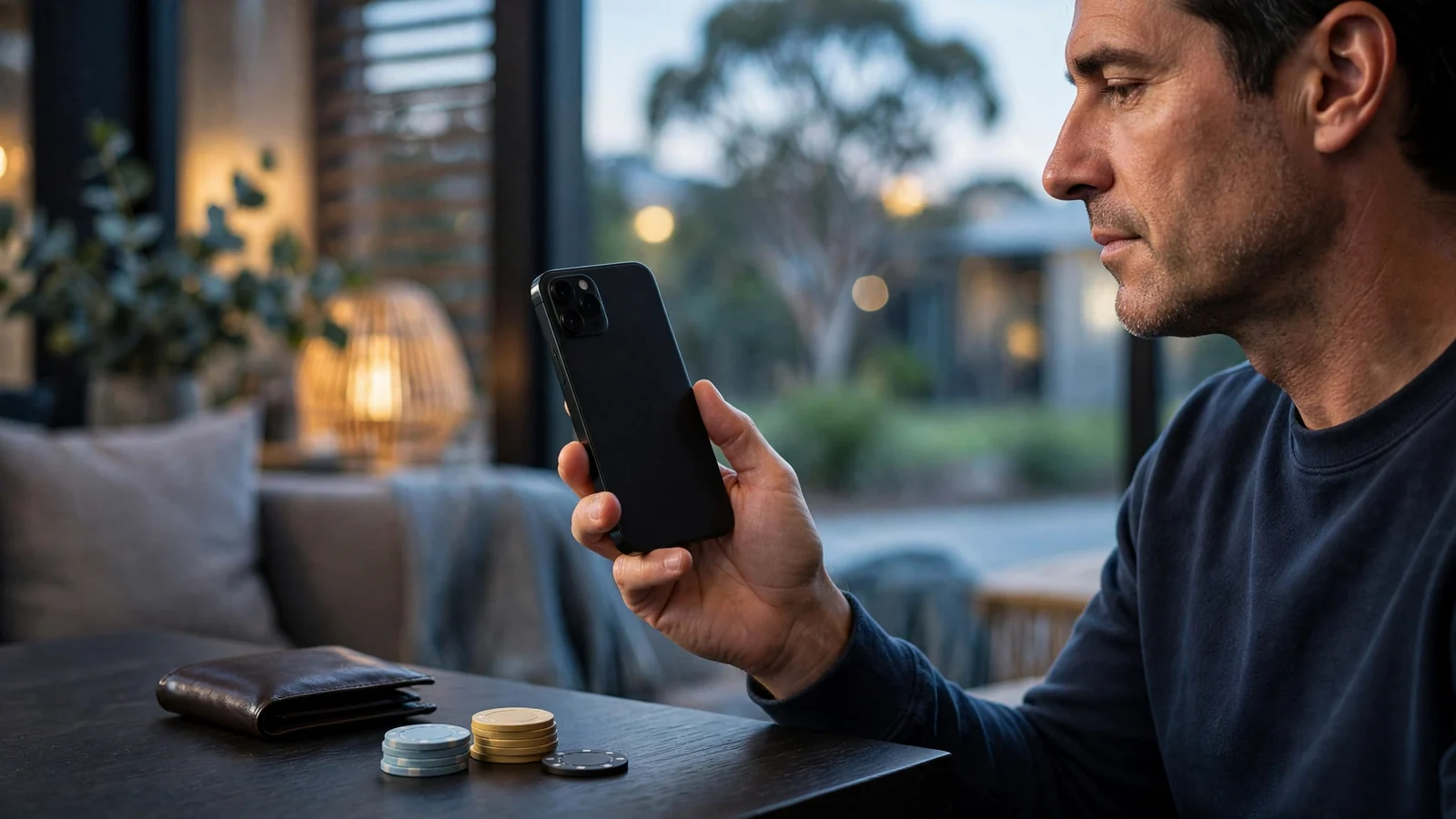
Real-Money Play: Understand the Risks Before You Deposit
With real-money play, a spin uses funds that have value outside the game. If a stake is lost, that money is gone; if a spin pays out, the balance may rise, but a win is never assured. That is the practical difference between real-money pokies and a free-play mode: in free play, credits are for the game and do not represent money you can lose or withdraw. Check which mode is active before you play, particularly if the same game offers both.
A displayed balance can make spending feel less immediate than paying for something directly. The balance is still your money once deposited. Decide what you can afford to lose before transferring anything, and treat that amount as an expense rather than money you expect to recover. Do not use funds set aside for rent, bills, food, debt repayments or other essential costs. If losing the amount would create pressure to deposit again, it is already more than you can comfortably risk.
Count the cost of getting money into the account
A deposit is not always as simple as entering an amount and seeing it arrive. A payment can be declined, delayed or treated differently by your bank or card provider. A specialist review reports that Australian banks and card companies are increasingly blocking transactions to known gambling sites. That is a reported pattern, not a guarantee about what your own bank will do: a payment that works once may not work later, and a decline does not mean you should keep trying other routes.
Cards can also carry a cost beyond the amount you intended to deposit. A specialist review notes that a bank or card issuer may classify a gambling deposit as a cash advance. In that case, a fee of 3–5% may apply, with interest starting immediately rather than after a usual purchase grace period. The classification and cost depend on the issuer and transaction, so check your card terms or ask the issuer before using it. If the transaction is treated as a cash advance, even a deposit that looks small on screen can cost more than expected.

Other payment methods do not remove the underlying risk: you are still transferring money for play. A specialist review describes Skrill and Neteller as popular for their speed and relative anonymity. Those qualities may make a payment feel easier, but they do not make losses less real or provide a reason to deposit more. Review the payment provider’s terms and the operator’s own payment information, and keep a record of what you transfer. Don’t assume that a payment will be reversible if you change your mind after playing.
Set limits before the first spin
The useful question is not how much you might win, but what amount you can lose without affecting the rest of your life. Set a firm spending limit in advance and stop when you reach it. A deposit limit can help keep transfers within a planned amount; a loss limit can put a boundary around what you are prepared to lose. Session-time limits can help you notice when play is taking longer than intended. These tools work best when chosen before you start, not adjusted upward in response to a losing run.
Keep separate track of deposits and remaining funds. A balance on the screen can encourage you to think of money already spent as still available, but it remains at risk while you continue playing. Do not borrow to fund a session or try to win back losses with another deposit. A run of losing spins does not make a win due: each spin is an independent random event. Previous results cannot tell you what the next one will be.
If you find that it is difficult to stop, or that gambling is interfering with bills, relationships or sleep, pause rather than adding funds. Self-exclusion is one available responsible-gambling tool. Taking a break can also give you time to look at the money you have spent without the pressure of an active session.
Before making any deposit, look at the payment method and your own account terms, not just the amount shown on the deposit screen. Confirm whether your bank may decline the transaction or classify it as a cash advance, and decide in advance how much you are willing to lose. If those costs or the possibility of losing the full deposit would put you under strain, do not deposit.
Do
- Set a firm spending limit in advance
- Keep separate track of deposits and remaining funds
- Use self-exclusion if you find it difficult to stop
Don't
- Use funds set aside for essential costs like rent or food
- Borrow money to fund a session
- Try to win back losses with another deposit
PayID Deposits: What the Payment Method Does—and Doesn’t—Tell You
PayID is a way to address a bank transfer, not a separate bank account or a gambling licence. It works as an alias layer on Australia’s New Payments Platform (NPP): instead of entering account details, a sender can use a recipient’s email address, mobile number or ABN. The NPP is supported by all major Australian banks and uses end-to-end encryption.
To use PayID for a real-money deposit at a site offering online pokies, you first need to link your PayID to a bank account. The payment still depends on that account and the bank behind it. PayID gives the transfer a simpler identifier; it does not remove the bank’s role or create a separate pool of funds.
That distinction matters if you are comparing payment options. A PayID deposit is a transfer initiated through your bank, rather than a payment made independently of it. Check which account is linked and what balance you intend to use before confirming anything. If the alias or recipient details do not match what you expect, pause and verify them through your bank’s own channels rather than relying on a message from the gambling site.
PayID’s connection to the NPP and its encryption describe features of the payment infrastructure. They do not tell you whether a gambling operator is licensed, whether its games are fair, or whether it clearly discloses return-to-player (RTP) settings. A site displaying a PayID option has shown that it can accept that payment route; it has not thereby supplied evidence about how its games work or what protections apply to you.
Treat those as separate checks. Payment availability answers a narrow question: can you attempt a transfer using this method? It does not verify the operator, the game software or the terms attached to your account. Likewise, an encrypted transfer protects information in transit, but it is not a guarantee about what happens after the money reaches the recipient. Do not use the presence of PayID as a shortcut for assessing anything beyond the payment method itself.

There can also be a bank-side obstacle. A specialist gambling-payment review reports that some Australian banks, including members of the Big Four, sometimes block PayID transfers to merchants identified as gambling businesses. A declined transfer may therefore reflect the bank’s controls rather than a fault with your PayID alias. The decision can depend on the bank and the merchant, so seeing PayID offered on a site does not ensure that your own transfer will go through.
If a payment is declined, check your bank’s explanation before trying again. Avoid repeatedly resubmitting a transfer or changing details to get around a block: a restriction is a reason to stop and clarify what happened, not evidence that another route is appropriate. You can contact the bank using its official app or contact details and ask whether it declined the transaction. Keep any payment confirmation or reference available if you need to discuss a completed transfer.
Before sending money, make sure you understand the recipient shown in your banking app and the amount being transferred. If the recipient name or payment instructions differ from what the site displayed, do not assume the difference is harmless. Confirm the details independently. PayID can make the addressing step more straightforward, but it cannot correct a mistake in the destination information you approve.
Some gambling sites describe PayID as a simple deposit choice. Read that claim narrowly. It says nothing by itself about whether you can withdraw through the same method, how an account is assessed, or whether the site provides clear game information. Those details need to be checked separately, and a payment logo is not a substitute for them. In particular, a listed RTP should be assessed from the game information provided, not inferred from the payment method.
If you are looking at Australian PayID pokies, keep the payment decision distinct from the decision to engage with real-money play. Linking an alias to your bank account makes a transfer possible; it does not make the transfer risk-free or tell you whether the destination deserves your trust. PayID is an infrastructure feature, not an endorsement.
The Australian Legal Position on Online Pokies
Casinos listed by licence
Choosing an online pokies site for Australia means checking the details that matter to you before you sign up. Use these notes to get a concise view of each operator’s stated licensing and any available payment information.
-
GoldenCrown
- License
- Curacao Gaming Control Board OGL/2023/176/0095 (Hollycorn N.V.)
GoldenCrown lists a Curacao Gaming Control Board licence, OGL/2023/176/0095, held by Hollycorn N.V.
-
SkyCrown
- License
- Tobique Gaming Commission
- Payout speed
- crypto ~10-15 minutes, fiat 1-5 days
- Min. deposit
- A$30
SkyCrown lists a Tobique Gaming Commission licence. Its stated payout times are around 10–15 minutes for crypto and 1–5 days for fiat, and the minimum deposit is A$30.
-
Playfina Casino
- License
- Curacao eGaming (Hollycorn N.V., since 2017)
- Min. deposit
- A$20-30 (depends on the offer)
Playfina Casino lists a Curacao eGaming licence held by Hollycorn N.V. since 2017. Its minimum deposit is A$20–30, depending on the offer.
-
JustCasino
- License
- Curacao Gaming Control Board
JustCasino lists a Curacao Gaming Control Board licence.
-
JeetCity Casino
- License
- Curacao eGaming (Dama N.V.)
JeetCity Casino lists a Curacao eGaming licence held by Dama N.V.
-
DragonSlots Casino
- License
- Curacao Gaming Authority (Jumpman Gaming Ltd)
DragonSlots Casino lists a Curacao Gaming Authority licence held by Jumpman Gaming Ltd.
-
Lucky Dreams
- License
- Curacao
- Min. deposit
- A$20 (POLi)
Lucky Dreams lists a Curacao licence and a minimum deposit of A$20 when using POLi.
-
SpinsUp
- License
- Curacao Gaming Control Board OGL/2023/174/0082 (Dama N.V.)
SpinsUp lists a Curacao Gaming Control Board licence, OGL/2023/174/0082, held by Dama N.V.
-
Wild Tokyo
- License
- Curacao
- Payout speed
- crypto 30-60 minutes, fiat 1-5 days
- Min. deposit
- A$10
Wild Tokyo lists a Curacao licence. Its stated payout times are 30–60 minutes for crypto and 1–5 days for fiat, and its minimum deposit is A$10.
-
Vegaz Casino
- License
- Curacao OGL/2024/1335/0780
- Min. deposit
- EUR 20
Vegaz Casino lists a Curacao licence, OGL/2024/1335/0780, and a minimum deposit of EUR 20.
The legal position on online pokies in Australia can seem contradictory: the law prohibits companies from providing these games to people in Australia, yet it does not make an individual player liable simply for playing. Keeping those two points separate is important. A site accepting Australian customers is not thereby authorised to offer real-money pokies here, and the fact that you can access a service does not establish that it is lawful for the operator to provide it.
The Interactive Gambling Act 2001 places the obligation on the company offering the service. It makes it illegal for an operator to provide real-money online pokies to Australian residents without a domestic licence. No licences of this kind have been issued, so there is no Australian-licensed online casino. In practical terms, an offshore operator cannot turn its service into a locally licensed one merely by welcoming Australian players or allowing them to register.
That distinction is different from saying that players face the same legal consequences as operators. The Act targets the companies providing the prohibited service, not individual Australians who use an offshore site that accepts them. An Australian player is not committing an offence simply by playing there. That does not make the operator’s service lawful in Australia, nor does it give the player the safeguards that would come with a domestic online-casino system.
What “legal to play” does—and does not—mean
If an offshore site allows you to play, the fact that it accepts Australian customers does not mean it holds an Australian licence. There is no such online-casino licence for it to hold. Nor should a site’s presentation, customer support or account features be confused with Australian authorisation. The central legal question is whether the company is permitted to offer real-money online pokies to people in Australia; under the current framework, the answer is no.
For you, the practical consequence is not that you face the operator’s legal penalty. It is that the relationship is not backed by an Australian-licensed online casino. If the site disputes a balance or refuses to pay winnings, Australian players have no legal recourse in Australia to compel an offshore casino to pay. A complaint may be possible through channels offered by the operator or its own jurisdiction, but that is not the same as having an Australian court or regulator able to provide a remedy under a local casino licence.
This matters most before you rely on an online balance as money you can recover. A displayed win is not the same as cash received, and the player’s lack of liability under Australian law does not create a right to payment that can be enforced here. The legal distinction protects players from being treated as the operators of an unlawful service; it does not ensure an offshore operator will honour a withdrawal.
Read the situation without confusing access and protection
Searches for Australian pokies online can lead to offshore services that appear available to local users. Availability answers only whether a site is accepting or reaching customers; it does not answer whether the company is licensed in Australia. Since no Australian-licensed online casino exists, there is no locally licensed option that resolves this concern.

It is also worth avoiding two opposite assumptions. The first is that an Australian player is breaking the law merely by using an offshore site; the law’s target is the operator. The second is that a site must be safe or accountable because it accepts Australians. That conclusion does not follow from the law, and it cannot provide a route to Australian legal recourse if a payment is withheld.
For a clear view of the risk, keep the roles distinct: Australian law prohibits operators from offering real-money online pokies here without a domestic licence, while players themselves are not made legally liable simply for playing at offshore sites that accept them. But because no domestic online-casino licences have been issued, an Australian player who is not paid by an offshore casino has no legal recourse in Australia to recover the winnings.
No-Deposit Offers: Read the Wagering Terms, Not Just the Headline
A no-deposit offer can sound cost-free because it does not require an initial deposit. That does not mean its bonus balance is ready to withdraw. Wagering requirements set the amount you must bet before winnings linked to an offer become eligible for cash-out. The headline amount matters less than the calculation behind it.
Check what the multiplier applies to. It may be based on the bonus alone, or on the deposit and bonus combined. Those two bases can produce very different turnover, even when the multiplier looks manageable. If the terms are unclear about which amount counts, you cannot reliably judge how much play is required.
A specialist review uses 35x or lower as a comparison point and describes requirements above 40x as punishing. Treat that as an assessment, not as a guarantee that a lower multiplier makes an offer worthwhile. The underlying amount and the other conditions still matter. A no-deposit offer can require substantial betting despite having no deposit attached; a deposit-linked offer can increase the calculation by including your own funds.
The scale is clearer with the examples in a specialist review. A $500 bonus at 40x creates $20,000 in required bets before any winnings can be withdrawn. If the terms apply 35x to a $500 deposit plus a $500 bonus, the required turnover is $35,000. In the second calculation, the multiplier applies to the combined $1,000, not just the bonus. A seemingly smaller multiplier therefore does not automatically mean less turnover.
Turnover is the total value of bets placed toward the requirement, not a target amount to win. Reaching it does not mean you will have that amount left to withdraw: each bet can reduce the balance, and play can end before the requirement is completed. The examples show why it is worth working out the qualifying amount before accepting an offer, rather than focusing on the advertised bonus figure.
Read the full terms for the calculation that applies to the specific offer. Check whether the wagering figure covers only bonus funds or the deposit as well, and whether the offer is genuinely no-deposit or requires a qualifying payment. Bonus codes and promotional labels do not explain these mechanics by themselves. The written conditions should make the required turnover and the amount it is based on clear.
If you cannot tell how the operator calculates the requirement, do not assume the more favourable interpretation. A bonus is not cash in hand, and accepting one may tie associated winnings to a substantial amount of further play. Compare the required turnover with the offer’s value before opting in; if the calculation does not make sense to you, leaving the offer unclaimed avoids taking on terms you cannot assess.
Free Spins and the Cash-Out Limit to Check
A free-spin offer can produce winnings without making all of them available for withdrawal. A specialist review has reported that some such offers set a maximum cash-out amount for winnings generated by the spins. The cap is a separate restriction from any wagering condition: completing a turnover requirement would not, by itself, remove a cash-out ceiling stated in the offer terms.
That distinction matters when you assess what the offer could actually be worth. If the spins generate less than the stated cap, the cap may not affect the amount available under that condition. If they generate more, the terms may limit what can be cashed out. The headline can therefore describe the spins offered while leaving a material restriction in the detailed terms.
Before accepting an offer, look for wording such as “maximum winnings”, “cash-out limit” or “maximum withdrawal” in the free-spin terms. Read the surrounding clauses rather than relying on a short banner or summary. Check whether the limit applies specifically to winnings from the spins, whether it is expressed as a maximum amount, and what happens to winnings above it. The wording should make clear what can be withdrawn; if it does not, do not assume the full displayed balance will be payable.
It can also help to separate the figures shown during play from the amount the terms allow you to cash out. A balance may reflect winnings on the account without showing how a promotional limit affects a later withdrawal. The key comparison is between the amount credited from the spins and the amount the offer permits you to withdraw under its conditions. Where those differ, the cap—not the larger figure on screen—sets the practical value of that part of the offer.
Treat the cap as a condition to understand before you opt in, not as a detail to investigate after a win. Save or reread the terms attached to the specific offer, since conditions can vary between promotions. If the terms are unclear about how the limit works, ask the operator for a direct explanation before you take part. A vague answer leaves you unable to judge what the offer would let you keep.
A cash-out cap does not tell you whether the underlying game is fair, nor does an attractive number of free spins establish that an offer is generous. It only describes a limit on the amount of winnings that may be withdrawn. Read that limit alongside the offer’s other conditions, and make your decision on the amount that could actually be cashed out—not the most appealing interpretation of the headline.
Sign-Up Bonuses: Check Withdrawal Conditions Before Claiming
A welcome offer can look straightforward while the conditions for receiving money later are easy to overlook. Before accepting a new-customer bonus, read the withdrawal rules that apply after play. They can affect when a cash-out is processed, how much can be paid at a time, and what documents you may need to provide.
Pay particular attention to any weekly or monthly withdrawal ceiling. A specialist review has reported examples of casinos setting these limits at $5,000–$10,000. Under a $5,000 monthly cap, for instance, paying out a $50,000 jackpot in full would take ten months, even if the balance were otherwise eligible for withdrawal. The figure is an illustration of how a cap can affect access to winnings, not a promise about a particular casino’s current terms. Check the specific operator’s rules and whether a limit applies to all withdrawals or only certain account types or winnings.

Look for the practical details, not just a headline claim that withdrawals are available. Is there a maximum amount per request? Does a larger balance have to be paid in instalments? Are weekly or monthly limits stated clearly? If the rules are unclear or difficult to find, you cannot reliably judge how long it might take to receive a large balance.
Identity checks can also delay a first withdrawal. Specialist reviews report that casinos may ask customers to verify their identity before releasing funds. The requested documents can include a photo of your ID and proof of address; some operators may also ask for a selfie holding the ID. Check which documents are required, how they must be submitted, and whether the details on your account need to match them. Do not wait until you request a cash-out to discover that a document is missing or unreadable.
Treat identity verification as a condition to understand before you deposit or claim an offer, not as a guarantee that a withdrawal will be paid. Read the terms alongside the operator’s identity-check instructions, and keep copies of what you submit. If the withdrawal rules or document requirements cannot be understood before you sign up, that uncertainty is itself relevant to your decision.
A sign-up bonus is not useful simply because it appears on the registration page. The important question here is what happens when you try to withdraw: whether a cap could spread payment over time, and whether you can meet the verification requirements. Check those conditions before accepting the offer, while you still have the choice not to proceed.
Using a Phone: Keep the Checks the Same as on Desktop
A phone can make it easier to open a site in a spare moment, but the smaller screen does not make the decisions involved any smaller. Whether you reach a page through a browser or an app offered by an operator, pause before playing and check the same things you would on a desktop. Do not assume that an app is available, or that its presence makes a service safer.
Keep your spending boundaries visible. Deposit limits can restrict how much you put in, while loss limits can help set a ceiling on what you are prepared to lose. Session-time limits can prompt you to stop rather than continue without noticing how long you have been playing. Self-exclusion is another responsible-gambling tool to consider if you need to block your own access. These tools are standard, but you should check whether they are available and how they work before relying on them.
Mobile layouts can place account controls in menus or behind small icons. Find the limit and exclusion settings before you start, rather than trying to locate them after a session has begun. If the controls are difficult to find or their effect is unclear, do not treat that as a reason to keep playing while you investigate.
A phone also makes it easy to switch between apps or respond to interruptions. That can break your attention without ending a session. Set a clear stopping point in advance, and use a session-time limit where available. If you have set a deposit or loss limit, do not raise it simply because a screen makes the change seem quick.
Privacy matters too: use a device you can access securely, and avoid leaving an account open where someone else might use it. Convenience is not a safeguard. The useful test for any mobile version is whether you can see and control your limits just as clearly as you can on a larger screen.

If you have excluded yourself, do not look for another device or access route to get around that decision. Self-exclusion only helps when you allow it to do its job. When using a phone, keep the same boundaries in place and stop if the experience is moving beyond them.
Online and Venue Pokies Are Not the Same Market
A pokie played through an online casino and a machine in a pub or club may share familiar features, but they belong to different settings. A screen-based game is accessed remotely; a venue machine is physically located where staff and other patrons are present. That difference affects the surroundings and the kind of support available if play becomes difficult to manage.
When people look for Australian casino pokies, they may mean machines they can play at a local venue, or online games presented as pokies. Those are not interchangeable options. A search for Australian casino pokies online points to remote play, while a question about Australian pokies machines may concern the machines installed in clubs, hotels or other venues. Check what setting is actually being discussed before relying on information about access or safeguards.
Venue requirements provide a useful example of how the two environments differ. A report by regionriverina.com.au says that, from 1 July, a venue with more than 20 gaming machines must have a dedicated Responsible gambling officer (RGO) on duty while those machines are operating. The report also describes a one-month grace period for venues to remove signage and introduce RGOs. These are venue-related measures; they should not be read as procedures that apply to a remote game.
The same report says venues will be required to maintain a gambling incident register. It is intended to record occurrences such as a patron showing behaviour that suggests they may be at risk of, or affected by, gambling harm. This reflects the fact that venue staff can observe and respond to conduct on the premises. Someone playing remotely is not in that shared physical environment, so the presence of an RGO at a club says nothing about the support arrangements attached to an online service.
If you are comparing a venue machine with a game described as an Australian online casino pokie, keep the comparison narrow: the name or style of a game does not make its setting, oversight or safeguards the same. The venue measures described in local reporting concern physical premises and the people working there. They do not establish that a remotely accessed game has equivalent staff support, and they should not be used to infer that it does.
Trust Checks for Offshore Sites—and Their Limits
A site that opens on your phone or accepts a registration is not thereby trustworthy. Access tells you only that the page is reachable at that moment; it does not confirm that the operator is accountable in Australia or that its claims can be independently checked.
The Australian Communications and Media Authority (ACMA) is responsible for enforcing the Interactive Gambling Act 2001. It blocks access to offshore gambling sites that breach the law, and internet service providers must follow ACMA’s blocklist. A site may therefore become inaccessible after you have encountered it, or access may be affected by blocking measures. Neither a page that loads nor one that fails to load is a reliable measure of an operator’s integrity.
There is no Australian-licensed online casino. That matters when you see a site described as an Australian pokies site: the wording does not mean it holds a domestic casino licence. Treat claims about local approval with care, and do not infer that an offshore operator is subject to Australian casino oversight simply because it accepts Australian visitors or uses familiar local language.

BetStop has an important limit too. It applies to Australian-licensed operators; it does not bind offshore sites. If you have self-excluded through BetStop, do not assume that an offshore site will recognise or enforce that exclusion. You may need to use separate blocking or support tools to help keep access under control.
Before deciding whether to trust any site, distinguish what you can observe from what it proves. A professional-looking page, working customer chat or available payment option cannot establish that the operator is licensed in Australia, that its games are fair, or that its payout promises will be honoured. These checks can help you spot unsupported claims, but they cannot turn an offshore site into an Australian-regulated service or remove the limits of protection available to you.
New Pokies: The Same Game Can Have Different RTP Settings
A newly released pokie is not automatically a better choice, and a game’s title alone does not tell you its return percentage. A specialist review reports that some providers let casinos choose between multiple RTP settings for the same game. As a result, identical pokies may be configured with different return percentages at different casinos.
That is a detail to check for the specific game and site, rather than assume from the game’s name or release date. If the RTP setting is not clearly stated, you cannot tell from the title which version is available. A higher stated RTP is a comparison of the game setting, not a promise about what you will receive.
RTP also does not predict the result of your next spin. Each spin is an independent event determined by a Random Number Generator. Previous wins or losses do not make a particular outcome due, and a run of results does not reveal which RTP setting is in use.
When considering new Australian pokies, separate two questions: what RTP setting is offered for that game, and what an individual spin might return. The setting may help describe the game’s return profile over time; it cannot remove uncertainty from a single play session. Take care not to treat a new release, a familiar title, or a displayed percentage as evidence that a win is likely.
Are online pokies legal for Australian players?
Yes, Australian players are not the target of the Interactive Gambling Act 2001 and can play on offshore sites that accept them. However, no Australian-licensed online casino exists, and you have no legal recourse in Australia if an offshore casino refuses to pay your winnings.
Can I play pokies for free?
Yes, if a game offers free-play mode. Its credits are for play only and cannot be withdrawn as money.
Do PayID deposits qualify for bonuses?
Yes, PayID is treated like other qualifying deposit methods at the recommended sites. Check the site's bonus terms to confirm whether a particular offer applies.